
We kids from the villages along the Penokee Range mining district attended the two grades per room Iron Belt Elementary School. Being the pre-digital era, that old school was equipped with a period appropriate audio-visual room.
A presentation in that audio-visual room was a really big event. Anticipation would build as the shades were drawn and the room darkened. Then came heightened anticipation with the initial clack-a-clack and flickering light from the ancient film projector. Then came the fascination of a larger-than-life story playing out on the pull-down screen before us, albeit a larger-than-life story with pulsating sound a millisecond out of synch with the imagery.
In the audio-visual room we saw epic stories and images from exotic places far away from our back wood’s villages.
Then the movie based on the children’s story “Paddle to The Sea” was shown on that wrinkly white screen. It featured a young native boy from Nipigon who one winter hand carved a floating scale model of an Ojibwe man in a traditional canoe. Underneath was carved, “My name is Paddle to The Sea. Please return me to the water”. Come spring Paddle to The Sea was released into Lake Superior and ultimately traversed into the Atlantic and wound up in France.
That movie resonated with me and demonstrated that the epic and exotic could indeed be very nearby. It also inspired me to hand build my own watercraft.
The vision when planning my first, a strip canoe made from red cedar and with a bird’s eye maple thwart and seat framing, was to build a beautiful craft that would be the envy of every canoe paddler. But my attention to detail was a little lacking and the results of my first attempt at fiberglass cloth-epoxy resin clear coating were less than stellar. The initial disappointment yielded to a realization that my very average results were actually a blessing in disguise.
Instead of building a canoe that was just too pretty to use, I had built a canoe that was very nice but not too nice to use. That cedar strip canoe was bounced off and had her bottom split once or twice by rocks in the lakes and rivers and creeks across Iron County. Her fiberglass was bruised from ricocheting off stumps and boulders and submerged logs. Her clear coating turned milky from the relentless scuffing and scraping against branches and brush. The beautiful cedar was eventually painted over with cedar bough camouflage.
She was paddled in the great Lakes Superior and Michigan. She was paddled in the mighty Colorado, Green, Platte, Mississippi, and Wisconsin Rivers. She was paddled in the mirage called Lake Havasu.

During a paddle in the latter part of a 300” snowfall winter, she silently glided within an arm’s length away from about a dozen whitetail deer traversing the ice-free stretch of the Montreal River-bed rather than trudging through the four-foot snowpack above the bank.
On the Platte River in Nebraska, the mellow current drifted me into the deafening cacophony of what seemed like a million sand hills cranes, and I glided into their midst before causing them alarm. I stared up in awe as the morning sun was momentarily darkened as the massive flock took to the sky.
Unbeknownst to me, I had floated into a wildlife viewing area, and all of the bird watchers on shore huddled in their blinds, binoculars in hand, glared back at me with looks that were anything but awe.
Sorry. But man, what an experience!
A stormy day on Lake Superior begged the experiment of seeing if my homemade recurved bow canoe with rather excessive tumblehome was up to task in the one-to-two-foot waves. The canoe handled the seas admirably, but the storm then began to build, and the waves rapidly grew in both size and anger. I paddled furiously towards shore hoping to beach the canoe before the waves overwhelmed her.
Then came a moment of Zen within the growing maelstrom. Suddenly the canoe felt light in the water and there was a surge of momentum shoreward, and she glided along effortlessly. That sudden smooth connection with an energy and motion that just a moment earlier was both brutal and rogue planted the seed for my next homemade watercraft. But that would happen a little later during the crisis of fading youth in my thirtieth year.
The story of why I built a surfboard when the nearest ocean is at least a time zone or two away has already been told.

But build a surfboard I did, and for my next 15 years I surfed Wisconsin. Why long for an ocean when we have a freshwater inland sea in our back yard?
The most challenging watercraft built was a small speedboat. But the conventional go-fast wisdom of the day was a huge offshore racer type boat. Think Crocket and Tubbs racing across Miami Bay in a behemoth boat, wearing stylish and well pressed pastel-colored suits and very expensive sunglasses and without a single hair buffeted out of place by the wind, all the while burning fuel at a rate that a Texas pumpjack could not keep up with.
I wanted small. The plan was to build a 14’ boat and the goal was 70 miles per hour. Easy peasy. In my naïve thinking, all a speedboat hull really needed to do was not sink and have a spot on back to clamp on a powerful motor capable of pushing her to 70 miles per hour.
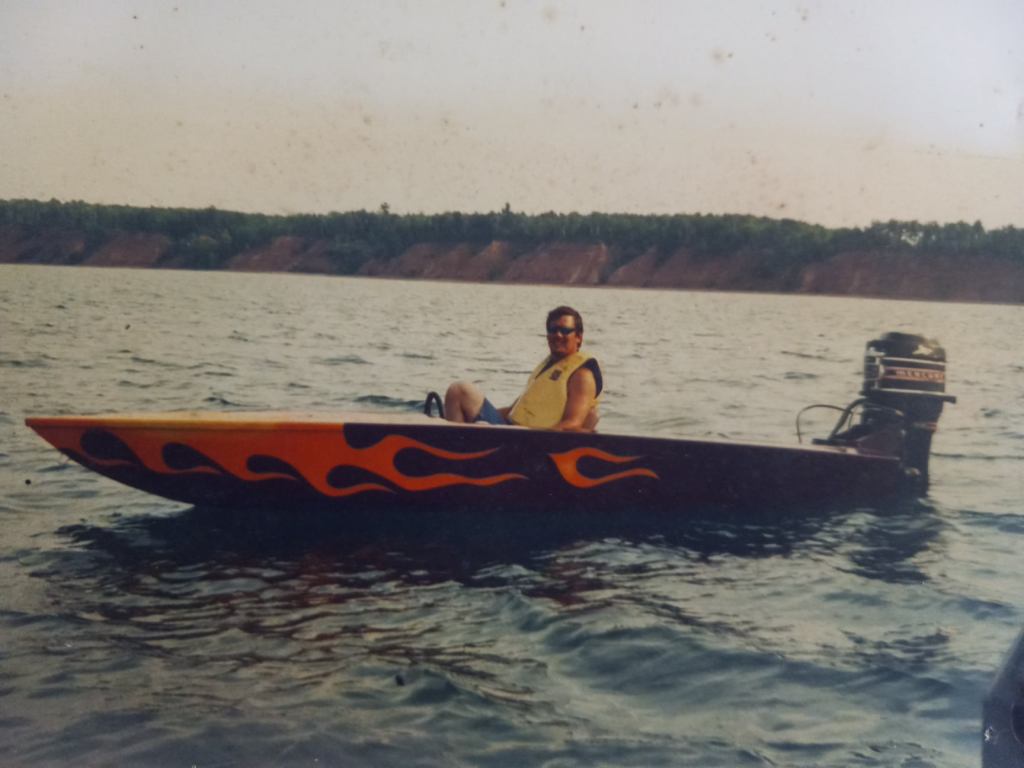
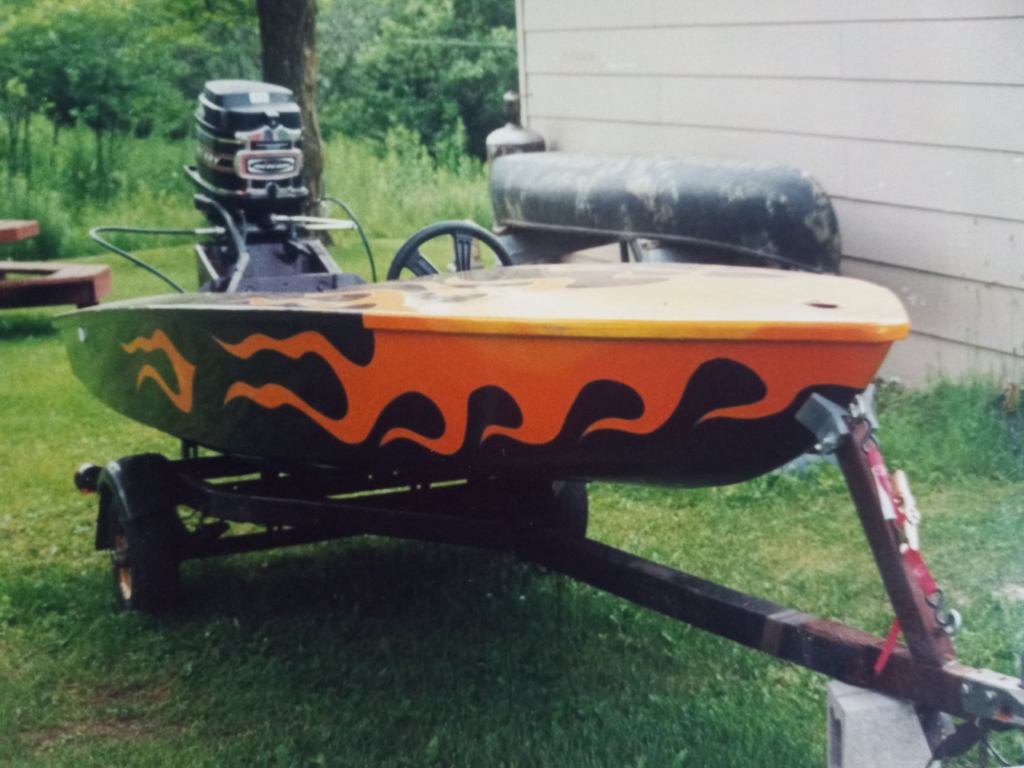
A flat bottom hard chine hull with a shallow vee entry was constructed out of knot-free red cedar framing sheathed with plywood then covered in fiberglass cloth and epoxy resin. It was finished with a glossy deep plum finish with racy yellow and orange flames painted from bow to past midship. A bold black Mercury 500 outboard set back 12” behind the transom towered over the diminutive hull.
When placed on a trailer and rolled out of the workshop and into the sun, she was beautiful. And if beauty equates with speed, 70 miles per hour was a slam dunk.
That year the Gile was unusually low with a lot of rocks and driftwood exposed, so the initial shakeout runs were very low speed and limited to the basics such as turn left, boat goes left; turn right, boat goes right.
Confident that it would not sink and had a powerful enough motor clamped on back, the boat was brought to Lake Superior for some high-speed testing. I do not remember the exact how or why, but my sister Lisa ended up in the passenger seat during that initial high-speed run. The boat handled well at lower speeds but began wildly porpoising as speed increased. Hoping to power through it, more throttle was fed and the porpoising became increasingly extreme and undulant and even the slightest steering input would cause the craft to veer violently.
Upon finally wrangling the speed back down into the realm of controllability, both my sister and I were ashen faced and white knuckled.
It turned out that a few simple but very fundamental tweaks made the boat not only controllable, but a superb performer. She could layover on edge and cut a corner as if on rails and would ultimately reach the speed of 62 miles per hour GPS powered by the gas sipping 50 horsepower motor. There was still a little speed left to be wrung out and there was no doubt that 70 was attainable. But she was simply too much fun as she was.
The music of Sublime was all the rage at the time, and I wanted to name the boat after one of their songs. She was christened “Bad Fish”, as Sublime’s most popular song “Date Rape” would not be a very appropriate name for a boat.
The wood hull of Bad Fish eventually became punky and worse for the wear, and she met an ignominious end at the local transfer station. I became misty-eyed and a lump formed in my throat upon seeing the sleek dark plum hull with the racy orange and yellow flame paint job lying forlornly amongst common trash.
The cedar strip canoe was given away to a restorer, the surfboard proudly hangs from my living room ceiling, and Bad Fish is buried in some landfill.
I am now an old man but am still in or by the water or on the ice most every day. The current fleet consists of a battered 12’ aluminum fishing boat found abandoned in the tall grass of a former hippy/gypsy squatter compound and an equally battered 16’ aluminum canoe that leaks but doesn’t sink purchased from Madeline who lives on Madeline Island. The “new” canoe has no name, but the aluminum fishing boat has been christened Bad Fish Too.

The main employment of Bad Fish Too is collecting data and samples from the Gile for the Citizens Lake Monitoring Network sponsored by the Wisconsin Department of Natural Resources.
This program has 1500 volunteers, including 500 that do water chemistry, collecting samples and data on over 1000 lakes statewide. In Iron County 42 volunteers monitor 36 unique stations on 28 lakes. Eight of those are on the Turtle Flambeau Flowage and I along with other volunteers monitor the one station on the Gile. Bad Fish Too is an important tool in this work.

Puttering along in a battered and painfully slow fishing boat collecting data and samples may seem pale in comparison to canoeing the great and wild waters, surfing Gitchi Guumii, or skimming across the water in a high-speed wooden bullet. But that is OK.
These days if I need excitement or an adrenaline rush out on the water, I take my hyper-energetic Golden Retriever pal Stormie the Trail Dog out for a paddle in the canoe that leaks but doesn’t sink. If that sounds dull, you have never been in a tippy leaky canoe with a Golden Retriever that has just spotted a goose or a loon nearby.
 The Unexpected Minimalist