The Northwoods abounds with natural beauty. We stand in awe of the natural treasures stretching from the splendor and majesty of Lake Superior and the remaining virgin timber in the North to the endless sandy beach shorelines of the constellation of lakes in the Northern Highlands to the south.
But within all of this natural beauty exists some man-made treasures as well.
The Black River Harbor and Park is a paradoxical place. Black River Road tumbles its way downslope, accessing exotic waterfalls while winding through magnificent old growth forests. But then the park entry is very mundane and a universal design common to most parks. The grounds lying beyond are very neat and extremely well kept but look like almost other every neat and well-kept park everywhere.
But strolling beyond and below the crest of the manicured grounds allows entry into another world. For there lies a picturesque marina with pleasure and fishing boats moored to a tree lined walkway and dock flanking the near bank of the Black River.
Spanning the Black River upstream is a rustic foot bridge constructed from timber harvested and milled onsite. The graceful suspension design lends the roughhewn structure an air of simple elegance.
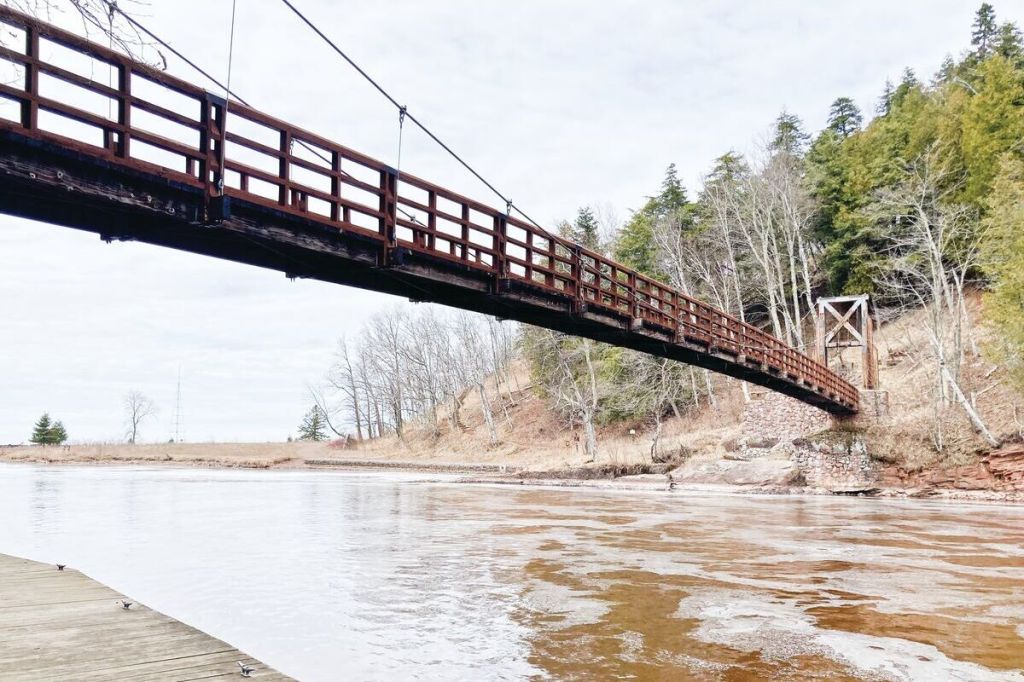
While the near end of the bridge is anchored onto the manicured grounds, the far end collides with the toe of a rugged bluff cloaked with towering ancient white cedar and pine and hemlock trees. A rustic trail is obligingly nestled between that bluff and the opposite shore of the Black and sweeps onto a wide and inviting sandy Lake Superior beach that stretches far off into the distance.
For generations, star-struck young couples met on those neat grounds, coyly strolled across that gently swaying bridge, and while on that magical beach beyond and with a million stars in the dark sky above as witnesses and with the waves lapping rhythmically at the shoreline, fell in love.
Constructed in 1936, the original Mercer Public Library and Community Center was built from locally felled virgin pine. Finnish woodsmen saddle coped and fitted the massive logs, resulting in not only an aesthetically pleasing building that oozed Northwoods appeal, but one that was also a tightly fitted and cozy sanctuary suitable for braving the extreme winters. But by the 1950’s the log building fell into disrepair and eventually ignominiously served as a mere storage building.
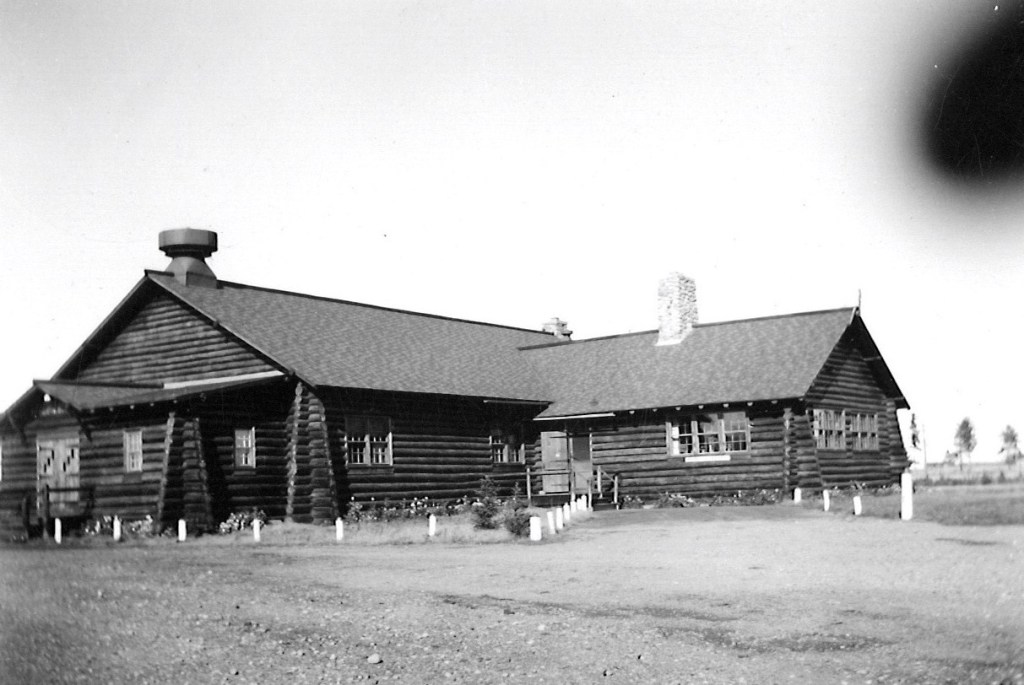
In the 1990’s, the old log structure was disassembled and lovingly repurposed and integrated into an expansion of the new Library and Community Center. This gave new life to the old structure and passed along the beauty and old soul of logs hewn by nameless and faceless woodsmen that history has long since forgotten.
The 105-acre Norrie Park is indeed a very sprawling park for Ironwood, MI, a city of only 4,957 residents.
Norrie Park began its life as the 3601st Company CCC Camp. Ultimately, that installation was decommissioned as the United States transitioned from the mass unemployment of the Great Depression to massive labor shortages in the runup to the Second World War. The actual camp barracks and many of the old structures had been removed as the grounds transitioned from camp to park, and park-related amenities were constructed. But those picturesque grounds remain and here and there are the remnants and ruins of carefully laid stone masonry structures that give clue to the past.

A constant is that generation after generation has loved Norrie Park, has grown up in it, and has grown old in it. It is a Western U.P. tradition for family gatherings, graduation parties, class reunions, wedding receptions; Norrie Park is a very happy and beautiful place that beckons pleasant congregation.
The Ironwood Township Resettlement was a grand social and economic experiment, a magnet garden community for struggling families. Sturdily built and sensibly attractive, the Resettlement’s brick homes were constructed in a row house type arrangement with very generous back yards for planting vegetable gardens and raising poultry and small livestock.

The Resettlement achieved its initial objective of preventing the Gogebic/Penokee Iron Range from depopulating during hard times. It has lived on long past that initial vision and purpose and has provided subsequent generations with durable and affordable housing stock.
The common thread winding through these local treasures is that each were WPA, the Work Progress Administration; or CCC, the Civilian Conservation Corp administered, and were government funded projects.
But what if these projects never happened?
The trout and salmon, the otters, and the ancient white cedar and hemlock of the Black River area would be doing just fine had humans never gained easy access. But generation upon generation of humans have stood in awe of the falls, the beauty of the Black River and Harbor, and the majesty of Lake Superior. If that park never was, what if it was your grandparents or parents that never met on those grounds or crossed the gently swaying bridge? If that park was never created, might you not even be?
Books can be stored efficiently in a warehouse. But what if the gravitational pull of an unknown ancestor hewing white pine logs with a broad ax and a draw knife was just enough to attract a present-day youngster away from antisocial media and into the woodsy and old soul sanctuary of today’s Mercer Library? What if that youngster then cracked the very book that sparked a curiosity that led to a lifetime of learning, and that lifetime of learning led to the next great medical or technological breakthrough?
Since the end of the Last Ice Age, the East Branch of the Montreal River has flowed as a wild torrent during the melt then dwindled to a lazy barely flowing stream in the dog days of summer and would continue to do so had Norrie Park never existed. But the joy of weathered grandparents witnessing their fresh-faced grandchildren playing in the very grass they once frolicked upon as young children might not be experienced as well.
Had the Resettlement never been built, its inhabitants would have drifted to somewhere that that held more promise. But the Resettlement was built and folks stayed. And before any better times came to the Northwoods, there came the dark clouds of war.
The Second World War was not only an epic battle between freedom and fascism, righteousness and genocide, but also a battle of economic and industrial might.
Would the fate of the world have turned out differently had our Iron Range depopulated? Would our Allied war machine have crumbled before the evil Axis war machine if the Gogebic and Penokee Range mines did not have a ready and available workforce able to swiftly produce the millions of tons of iron ore that were hurled towards the war effort?
Each of these projects were proposed during the most difficult of times by forward-thinking minds and implemented by hardworking people. These projects were expensive at a time when every penny mattered, but the powers-that-be made a conscious decision to invest in the lives of everyday people. And those everyday people invested the fruits of their labor to deliver an enduring product and legacy. These projects not only achieved the short-term goals of instilling economic and community stability but provided a lasting and very enduring legacy to be enjoyed on a much grander scale for generations to come.
Despite all the current whining, misguided self-pity, and misinformation, we in these United States of America are currently living at an unprecedented apex of wealth and security. Yet each of these projects, if proposed today, would fail the current political litmus tests and would not be constructed. And this begs the question, what if any positive legacy are we leaving for those who follow?
Are we willing to create special places and projects that impart a sense of security and community and inspire joy and wonder, all to be enjoyed well into the next century? Are we going to make an investment toward the happiness and sense of wellbeing of those who follow? Or are we going to be self-centered and miserly?
 The Unexpected Minimalist