Bad Fish Too

We kids from the villages along the Penokee Range mining district attended the two grades per room Iron Belt Elementary School. Being the pre-digital era, that old school was equipped with a period appropriate audio-visual room.

A presentation in that audio-visual room was a really big event. Anticipation would build as the shades were drawn and the room darkened. Then came heightened anticipation with the initial clack-a-clack and flickering light from the ancient film projector. Then came the fascination of a larger-than-life story playing out on the pull-down screen before us, albeit a larger-than-life story with pulsating sound a millisecond out of synch with the imagery.

In the audio-visual room we saw epic stories and images from exotic places far away from our back wood’s villages.

Then the movie based on the children’s story “Paddle to The Sea” was shown on that wrinkly white screen. It featured a young native boy from Nipigon who one winter hand carved a floating scale model of an Ojibwe man in a traditional canoe. Underneath was carved, “My name is Paddle to The Sea. Please return me to the water”. Come spring Paddle to The Sea was released into Lake Superior and ultimately traversed into the Atlantic and wound up in France.

That movie resonated with me and demonstrated that the epic and exotic could indeed be very nearby. It also inspired me to hand build my own watercraft.
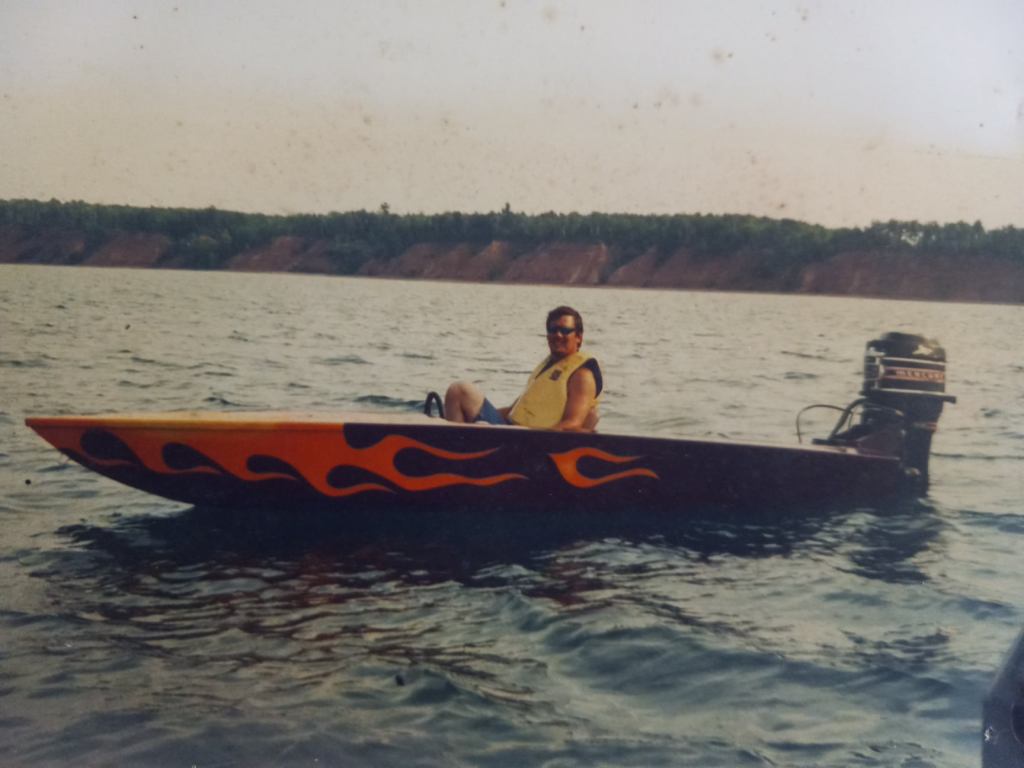
Who is that snot nose young punk in the hot boat out on Lake Superior?

The vision when planning my first, a strip canoe made from red cedar and with a bird’s eye maple thwart and seat framing, was to build a beautiful craft that would be the envy of every canoe paddler. But my attention to detail was a little lacking and the results of my first attempt at fiberglass cloth-epoxy resin clear coating were less than stellar. The initial disappointment yielded to a realization that my very average results were actually a blessing in disguise.

Instead of building a canoe that was just too pretty to use, I had built a canoe that was very nice but not too nice to use. That cedar strip canoe was bounced off and had her bottom split once or twice by rocks in the lakes and rivers and creeks across Iron County. Her fiberglass was bruised from ricocheting off stumps and boulders and submerged logs. Her clear coating turned milky from the relentless scuffing and scraping against branches and brush. The beautiful cedar was eventually painted over with cedar bough camouflage.

She was paddled in the great Lakes Superior and Michigan. She was paddled in the mighty Colorado, Green, Platte, Mississippi, and Wisconsin Rivers. She was paddled in the mirage called Lake Havasu.

On the slickrock somewhere in Utah trying to find access to the mighty Green River

During a paddle in the latter part of a 300” snowfall winter, she silently glided within an arm’s length away from about a dozen whitetail deer traversing the ice-free stretch of the Montreal River-bed rather than trudging through the four-foot snowpack above the bank.

On the Platte River in Nebraska, the mellow current drifted me into the deafening cacophony of what seemed like a million sand hills cranes, and I glided into their midst before causing them alarm. I stared up in awe as the morning sun was momentarily darkened as the massive flock took to the sky.

Unbeknownst to me, I had floated into a wildlife viewing area, and all of the bird watchers on shore huddled in their blinds, binoculars in hand, glared back at me with looks that were anything but awe.

Sorry. But man, what an experience!

A stormy day on Lake Superior begged the experiment of seeing if my homemade recurved bow canoe with rather excessive tumblehome was up to task in the one-to-two-foot waves. The canoe handled the seas admirably, but the storm then began to build, and the waves rapidly grew in both size and anger. I paddled furiously towards shore hoping to beach the canoe before the waves overwhelmed her.

Then came a moment of Zen within the growing maelstrom. Suddenly the canoe felt light in the water and there was a surge of momentum shoreward, and she glided along effortlessly. That sudden smooth connection with an energy and motion that just a moment earlier was both brutal and rogue planted the seed for my next homemade watercraft. But that would happen a little later during the crisis of fading youth in my thirtieth year.

The story of why I built a surfboard when the nearest ocean is at least a time zone or two away has already been told.

Ocean? We don’t need no ocean!

But build a surfboard I did, and for my next 15 years I surfed Wisconsin. Why long for an ocean when we have a freshwater inland sea in our back yard?

The most challenging watercraft built was a small speedboat. But the conventional go-fast wisdom of the day was a huge offshore racer type boat. Think Crocket and Tubbs racing across Miami Bay in a behemoth boat, wearing stylish and well pressed pastel-colored suits and very expensive sunglasses and without a single hair buffeted out of place by the wind, all the while burning fuel at a rate that a Texas pumpjack could not keep up with.

I wanted small. The plan was to build a 14’ boat and the goal was 70 miles per hour. Easy peasy. In my naïve thinking, all a speedboat hull really needed to do was not sink and have a spot on back to clamp on a powerful motor capable of pushing her to 70 miles per hour.

A flat bottom hard chine hull with a shallow vee entry was constructed out of knot-free red cedar framing sheathed with plywood then covered in fiberglass cloth and epoxy resin. It was finished with a glossy deep plum finish with racy yellow and orange flames painted from bow to past midship. A bold black Mercury 500 outboard set back 12” behind the transom towered over the diminutive hull.

When placed on a trailer and rolled out of the workshop and into the sun, she was beautiful. And if beauty equates with speed, 70 miles per hour was a slam dunk.
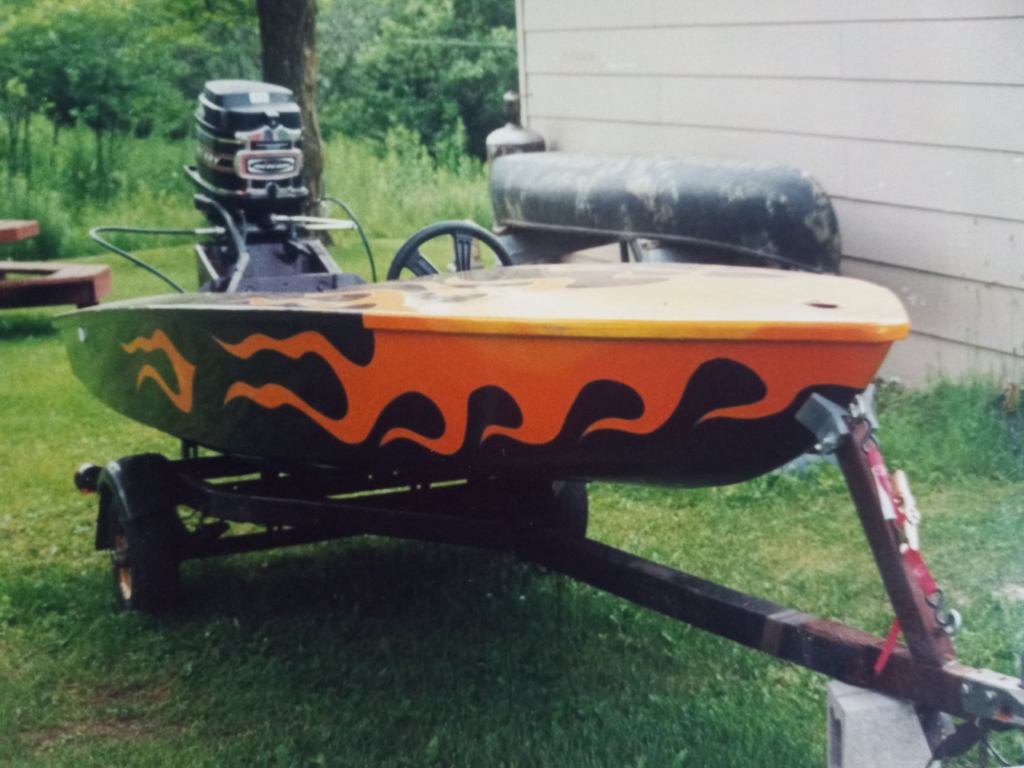
Bad Fish and the cedar strip canoe

That year the Gile was unusually low with a lot of rocks and driftwood exposed, so the initial shakeout runs were very low speed and limited to the basics such as turn left, boat goes left; turn right, boat goes right.

Confident that it would not sink and had a powerful enough motor clamped on back, the boat was brought to Lake Superior for some high-speed testing. I do not remember the exact how or why, but my sister Lisa ended up in the passenger seat during that initial high-speed run. The boat handled well at lower speeds but began wildly porpoising as speed increased. Hoping to power through it, more throttle was fed and the porpoising became increasingly extreme and undulant and even the slightest steering input would cause the craft to veer violently.

Upon finally wrangling the speed back down into the realm of controllability, both my sister and I were ashen faced and white knuckled.

It turned out that a few simple but very fundamental tweaks made the boat not only controllable, but a superb performer. She could layover on edge and cut a corner as if on rails and would ultimately reach the speed of 62 miles per hour GPS powered by the gas sipping 50 horsepower motor. There was still a little speed left to be wrung out and there was no doubt that 70 was attainable. But she was simply too much fun as she was.

The music of Sublime was all the rage at the time, and I wanted to name the boat after one of their songs. She was christened “Bad Fish”, as Sublime’s most popular song “Date Rape” would not be a very appropriate name for a boat. 

The wood hull of Bad Fish eventually became punky and worse for the wear, and she met an ignominious end at the local transfer station. I became misty-eyed and a lump formed in my throat upon seeing the sleek dark plum hull with the racy orange and yellow flame paint job lying forlornly amongst common trash.  

The cedar strip canoe was given away to a restorer, the surfboard proudly hangs from my living room ceiling, and Bad Fish is buried in some landfill.

I am now an old man but am still in or by the water or on the ice most every day. The current fleet consists of a battered 12’ aluminum fishing boat found abandoned in the tall grass of a former hippy/gypsy squatter compound and an equally battered 16’ aluminum canoe that leaks but doesn’t sink purchased from Madeline who lives on Madeline Island. The “new” canoe has no name, but the aluminum fishing boat has been christened Bad Fish Too.

The canoe that leaks but doesn’t sink.

The main employment of Bad Fish Too is collecting data and samples from the Gile for the Citizens Lake Monitoring Network sponsored by the Wisconsin Department of Natural Resources.

This program has 1500 volunteers, including 500 that do water chemistry, collecting samples and data on over 1000 lakes statewide. In Iron County 42 volunteers monitor 36 unique stations on 28 lakes. Eight of those are on the Turtle Flambeau Flowage and I along with other volunteers monitor the one station on the Gile. Bad Fish Too is an important tool in this work.

Puttering along in a battered and painfully slow fishing boat collecting data and samples may seem pale in comparison to canoeing the great and wild waters, surfing Gitchi Guumii, or skimming across the water in a high-speed wooden bullet. But that is OK.

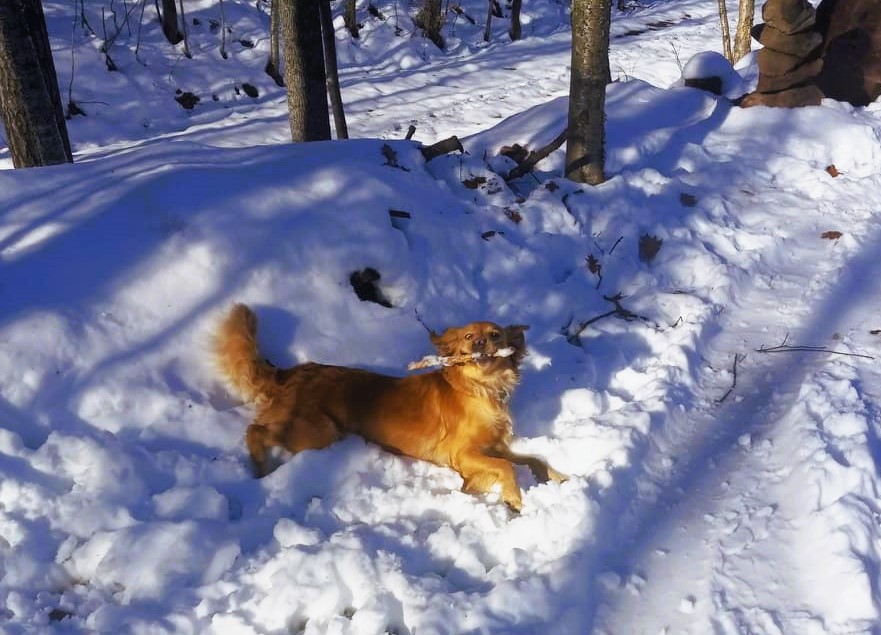
These days if I need excitement or an adrenaline rush out on the water, I take my hyper-energetic Golden Retriever pal Stormie the Trail Dog out for a paddle in the canoe that leaks but doesn’t sink. If that sounds dull, you have never been in a tippy leaky canoe with a Golden Retriever that has just spotted a goose or a loon nearby.
Dabbling in Consumerism

Late last fall and early winter three things happened that made me rethink things. Rethink things to the point that it may ruin my junkman cred.

The first was that Stormie the Trail Dog chased off after a sound in the night. Instinct prompted my grabbing the pistol, just in case it was a black bear, cat, coyote, or wolf she might be foolishly pursuing. But the accompanying flashlight was nowhere to be found.

I raced out into the dark of night and over a drop off, plunging to the bottom. The pain was incredible, it seemed my legs did not want to move, and I dragged myself back up to the top and back to the cabin using only my arms. There was no actual paralysis, but the pain of a broken rib and being banged up from the fall tricked me into feeling that there was.

A rather arduous healing process convinced me that I was no longer a spring chicken and maybe, just maybe, was also no longer invincible.

The second was that the Ting Quad, my vintage 1999 Suzuki ATV, simply quit running and at a most inopportune time.

The third was looking out over this amazing homestead created within the majestic Northwoods and realizing that it was beginning to look like a junkyard that could make Fred Sanford cringe.

“Dad”, my son intervened, “you are out there by yourself relying on pieces of junk for your existence. Some day we are going to find you frozen to death in snowbank next to a broken-down piece of shit”. That was a not so far-fetched point.

Oops

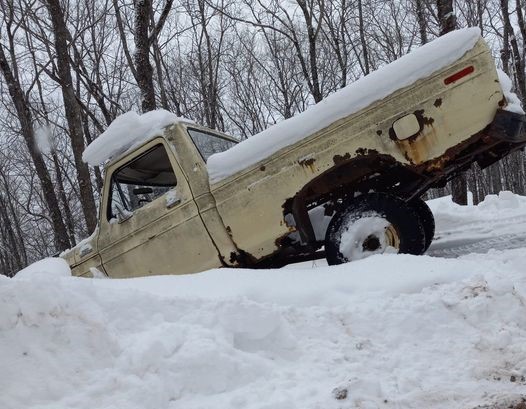
Old Yeller, my hand-me-down 1978 Ford plow truck had no operational brakes since the middle of the Obama years and the cab became so rusty that pushing the clutch pedal to floor produces no disengagement but jacks the floating cab about a bit. Stops were achieved by killing the ignition or snuffing the engine.

Except for the roadless first winter-and-a-half relying on a 2003 Skidoo Tundra and the Ting Quad for access into the homestead, Old Yeller and a 1980 John Deere track loader have been relied upon to keep the half mile long way in open for winter access.  There have been a few sketchy and wild times, but overall, they performed admirably.

The freakish nearly snowless winter of ‘23/’24 produced the lowest prices and greatest availability of new snowmobiles since the advent of the pandemic. The market dynamics had shifted so much towards the consumer that I began to look at that old Tundra in a more realistic light.

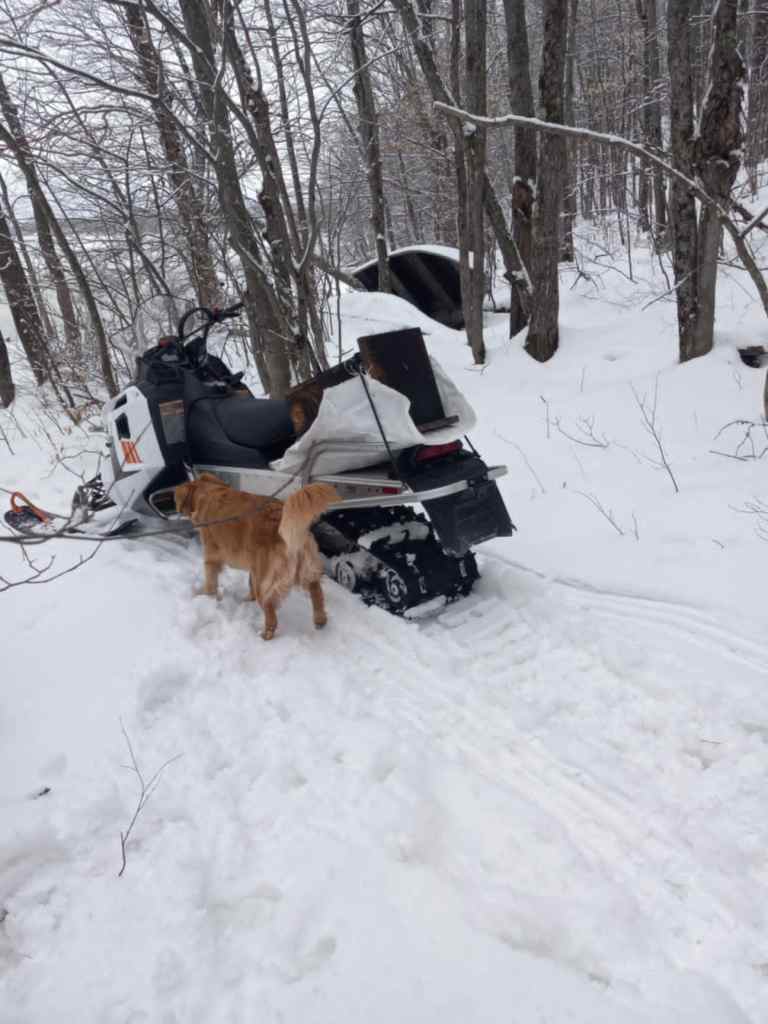
A shiny new Polaris Voyageur 155 with a freakishly long track and almost comically wide flotation skis found a place in the garage and the vintage Tundra found a new home with a vintage Tundra aficionado.

Does one truly need a shiny new Polaris snowmobile? Well, not really.

But there are times most winters when the way out becomes snowbound or blocked by a piece of broken-down equipment, and it is sure nice having a snowmobile to get into town for a part or some anti-gel and fresh diesel fuel. But riding a snowmobile down a snowmobile trail for the sake of riding a snowmobile down the trail is not fun for me. However, riding overland to quickly cover some ground to get to a back country adventure or snowshoe excursion, or to get out on the ice to visit with those out ice fishing truly makes the snowy six months of the year most enjoyable.

Putting out Wood Duck nests with the Voyageur

And this was my first new snowmobile, ever.

Most folks get a buyer’s high when making a purchase, but my reaction is the exact opposite. There always is intense buyer’s remorse, even before making a purchase. Knowing this, I looked carefully at the weak links in the stuff that supports this out-in-the-sticks lifestyle. With a bout of buyer’s remorse from the Polaris already in play, the timing was ripe to commit to a rather large purchase that would eliminate at least three very integral pieces of junk from the fleet.

I bought a Can-Am six-wheel drive UTV and a heavy-duty vee-scoop action snowplow for it.

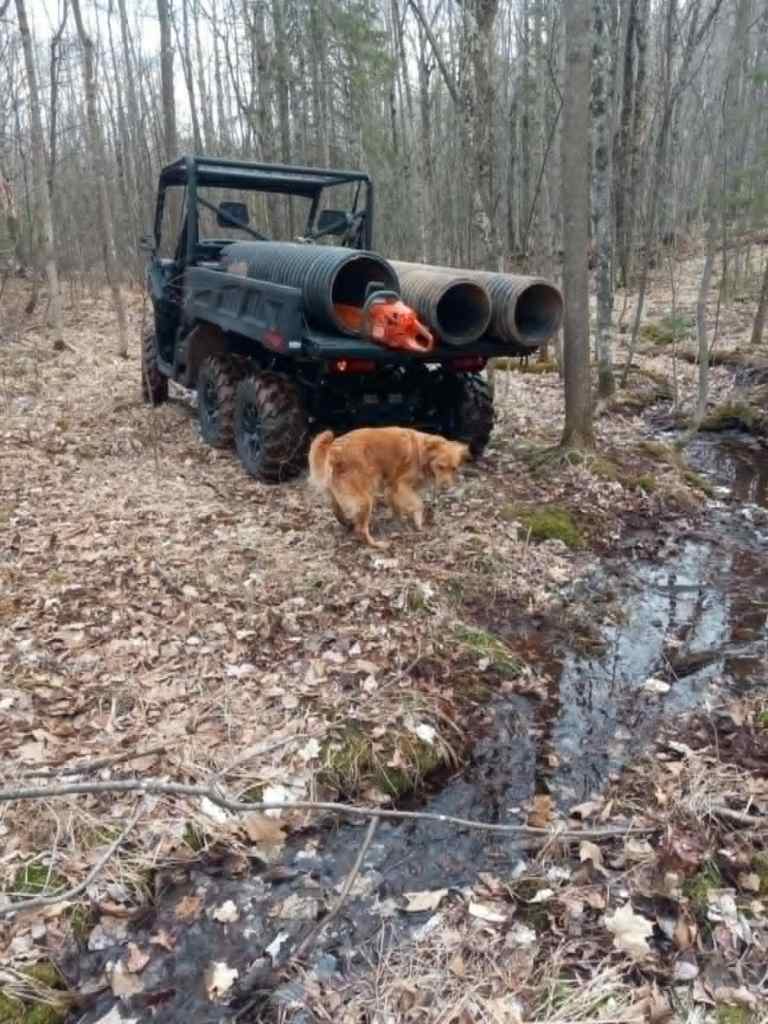
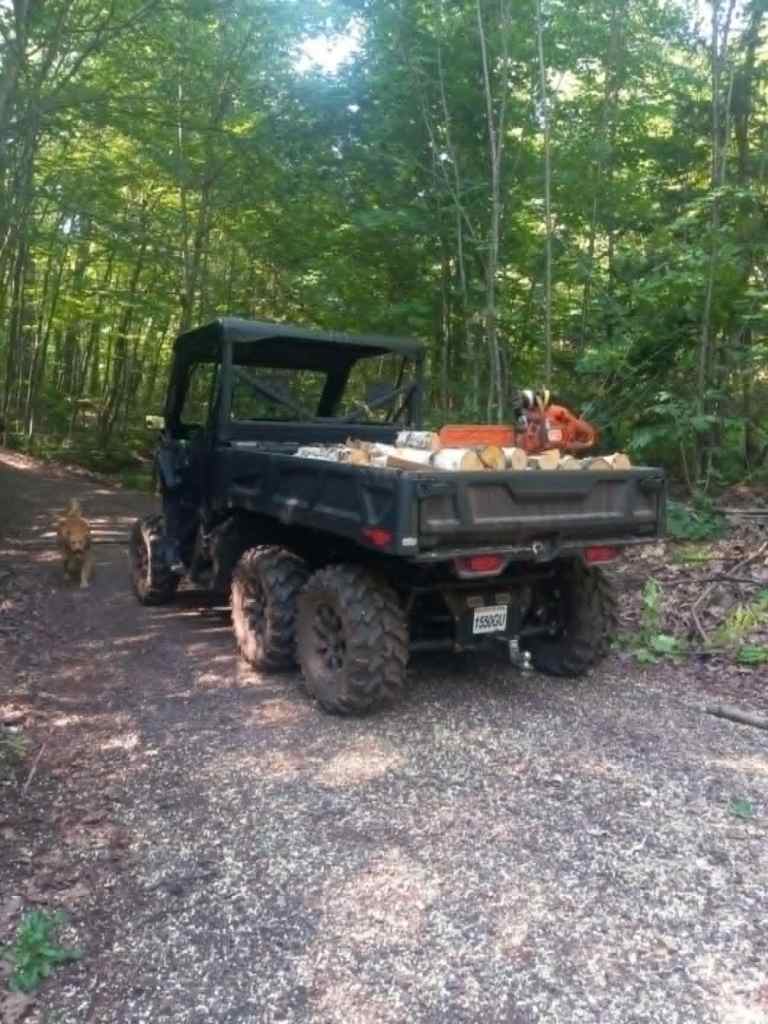
The 6×6 has proven to be a very capable workhorse and has replaced two smaller ATVs and Old Yeller. It tackles every imaginable task thrown at it. At first the cargo box seemed awkwardly large for a UTV, but that copious size soon proved its worth when making firewood. No longer is it necessary to wedge my late model Ford Ranger pickup between the trees to perform the larger tasks, as in most cases is the 6×6 is at least capable and often is more so. It also doesn’t dent.

So, the fleet has been upgraded and downsized and some old junky friends have found new homes. Hopefully I did my homework well and bought the most capable and reliable snowmobile and UTV possible and they will be fun tools that last the rest of my life.

And now might be a good time to repair the accumulated dents in the Ranger.

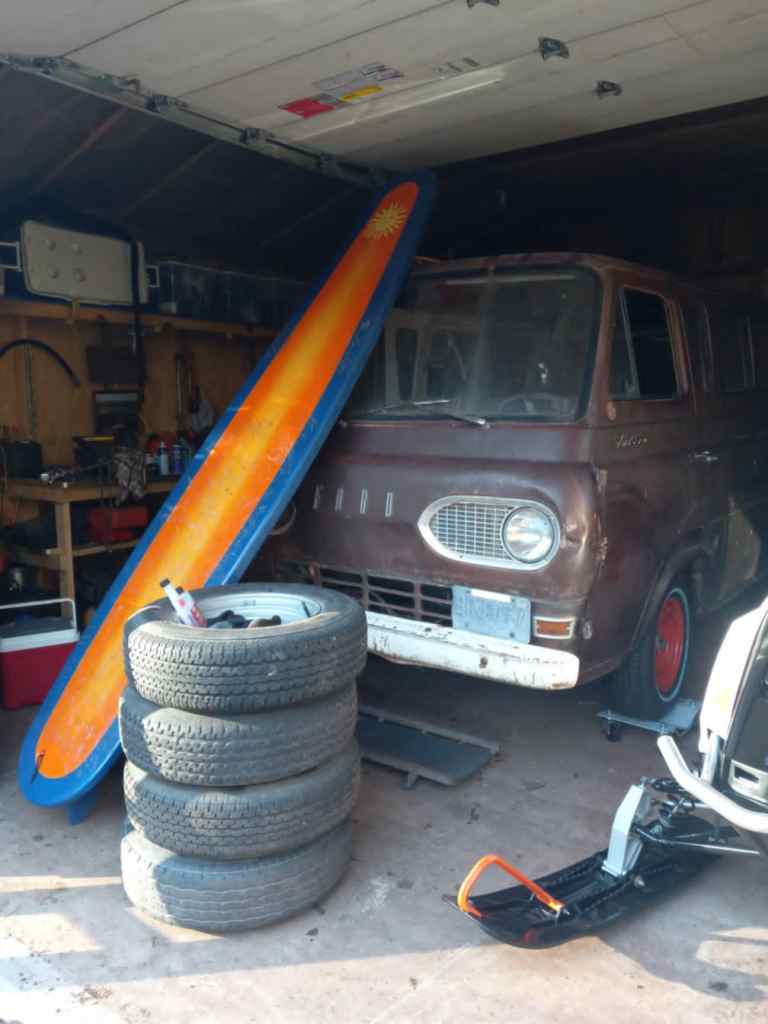
There still are, however, a few junkyard dalliances in the garage, if for no other reason than to keep life interesting. A neglected cast-off snowcat trail-groomer is being refurbished and this winter will be an interesting experiment in keeping the accumulated snowbanks pushed back. Old Yeller the plow truck is now officially retired and is currently on life support. But his heart, the mighty and trusty Ford 300 six under his rusty hood, will be transplanted into the 1965 Ford Econoline Western Hemisphere Traveler Hippy Van.

Meanwhile back in the garage-the Voyageur awaits snow, the Hippy Van awaits a transplant, and the homemade surfboard gathers dust.

Downsizing and focusing on two new things and a mere two additional pieces of junk rather than trying to keep a three-ring circus of junk going should still provide plenty of excitement. Reports to follow!

The End of an Era

Honestly, who really thinks about a dresser?

When purchasing a bedroom set it is the size of the bed and comfort of the mattress that are of great importance. The dresser is simply a big box that holds copious amounts of clothes, most of which we never wear. The dresser does a good job holding up a mirror.

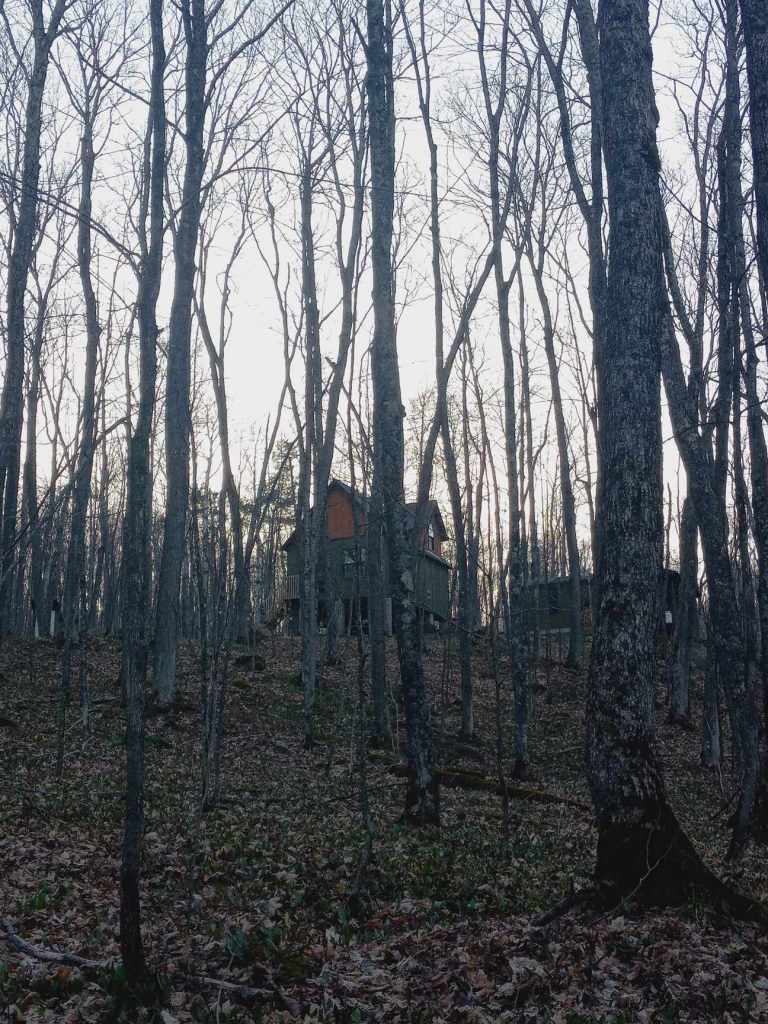
There was a lot of time to think about the design and spatial requirements of the cabin I now call home. The plan was to live smaller and with less stuff. Less stuff requires less space, including less closet space. Rather than have larger closets that burned up perfectly good floor area, two smaller clothes closets were built into otherwise unusable nooks facing each other. There was enough space in between for a small dresser. A local antique shop had a smallish dresser with a broken drawer and a horrible paint job that was hidden away in a corner. It was the perfect size.

Normally the purveyor of antiques or junk can put the most positive spin on the most worthless wares. But she incredulously replied, “That?” upon my inquiry.

I asked if it could be purchased then stored onsite. There was no room inside the cabin during construction and it would certainly meet its demise stored outside, no matter how well covered. “Sorry”, she replied.

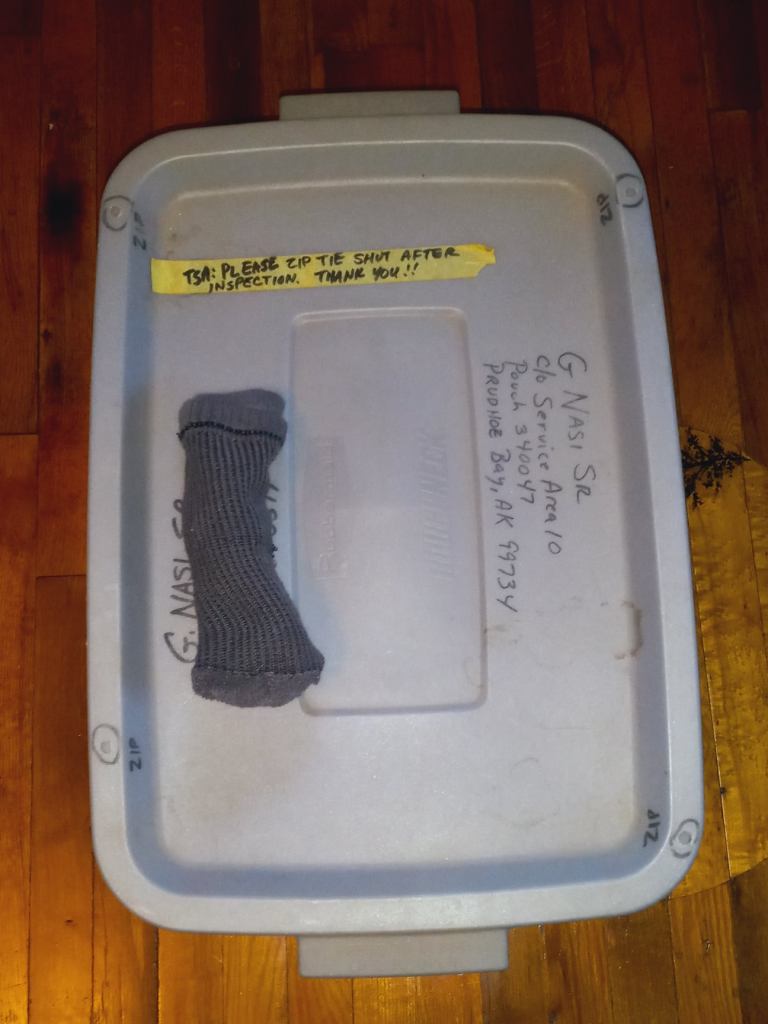
For eight out of ten years a while back, I had carted around my clothing and minimal necessary possessions in plastic totes while chasing the almighty buck all across North America. That storage habit would have to continue a little longer as the work on the cabin progressed, and my clothing would continue to stink like cheap plastic.

It seemed a worthy gamble that nobody would ever want that little dresser. But much to my surprise and dismay, about a week before finally being ready to make the purchase, somebody else spied the forlorn treasure and it was gone.

The newly manufactured dressers available were much too large to fit within the constructed space, and it looked like the future held only the promise of my clothes continuing to stink like cheap plastic.

The million-mile tote

The story about Roland Reisly, the last living client to personally commission Frank Lloyd Wright to build a home while the famed architect was still alive has recently been making the rounds.

Not Mr. Reisly’s house. Mine, out of the land yet a product of the land.

Mr. Reisly has been living in a Wright designed home since 1951 and partially attributes his long and happy life with simply being surrounded by beauty. And without question, he certainly lives in a beautiful home placed within a beautiful setting.

The furniture and fixtures within are unique and custom designed. Every individual element down to the most minute detail is an integral part of the larger whole. That resultant larger whole is an elegantly shaped and pleasingly proportioned home, adorned with visual delights. It is constructed of an amalgam of sturdy wood, rugged local stone, and sleek glass, all existing in harmony within a natural setting.

The home seems to have organically sprouted from then sprawled out upon the landscape.

I do not recall hearing of Mr. Reisly or his comments previously, but like most others on Planet Earth am familiar with Frank Lloyd Wright and can readily identify his work or similar works either plagiarized from or inspired by him. But the Wright concept of being surrounded by beauty must have been present during that time to think. Or perhaps by happy accident, maybe that time to think simply was put to good use.

There was time to imagine a future; lying in bed and gazing in awe through one window at a distant galaxy splashed across the dark night sky and out another window at the dancing Aurora Borealis. Time to imagine stark monochromatic walls adorned with a copious number of windows and accented by warm amber cedar ceilings. Time to imagine a home that both jauntily bursts forth out of the landscape while simultaneously and harmoniously coexisting within that same landscape.

Now, Frank Lloyd Wright I ain’t. My little mind’s eye visions incorporated into the little cabin are just that, mine and are strictly for my own consumption. You will never see my little cabin reaping accolades or gracing the pages of a glossy coffee table book. But just like Frank Lloyd Wright’s last living client, I am surrounded by beauty.

 I am surrounded by my perceived beauty of the cabin, the beauty of views that blur the concept of inside and outside, the beauty of the Great Northwoods that envelopes both the cabin and my very existence. The beauty of creating something with help from family and friends but mostly with my own two hands.

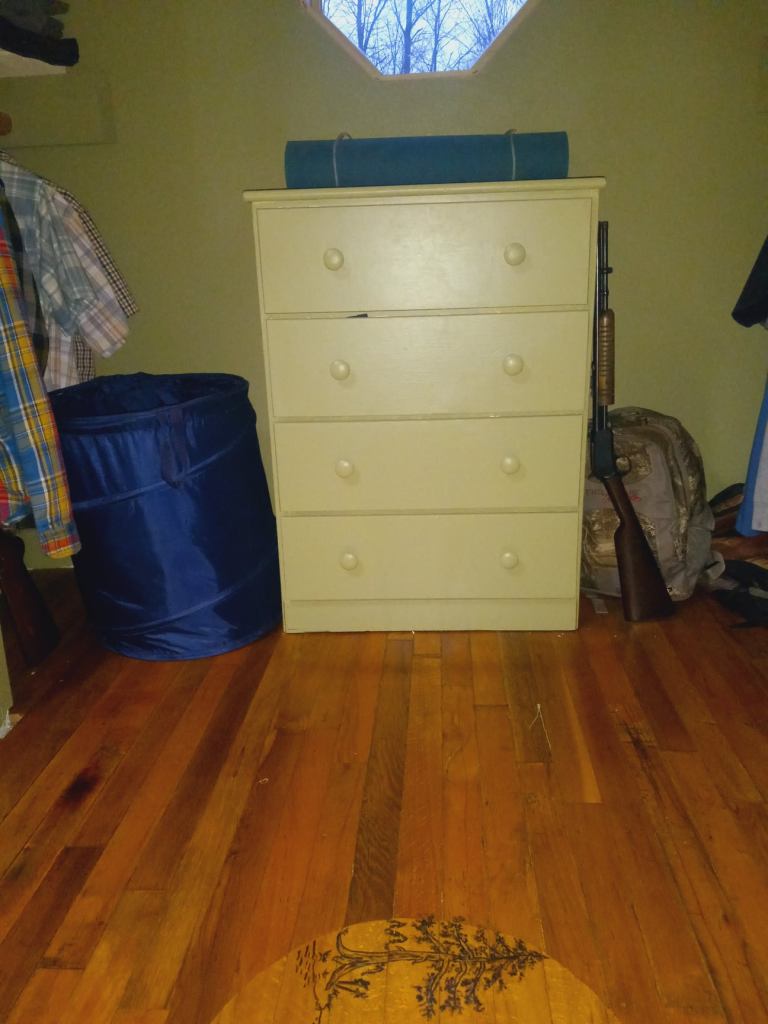
My sister helped someone move out of their home and was gifted a nearly cast-off dresser. She gifted it to me, and it was given a fresh coat of paint. While not the precisely the same size as the long-lost dresser, it fits neatly into the constructed space.

I see the beauty of a freshly painted dresser getting a second chance in life rather than being cast into a dumpster. The permanence of my clothes stored within that dresser and not a plastic tote. The beauty of an end of one era and the beginning of another.

And the hope that there is never the need to live out of a plastic tote again.     

The Promise of New

Most folks I’ve talked to were rather happy to see 2023 end.

It’s not that it was necessarily a horrible year filled with wholesale war and disease and civil disorder and apocalyptic horsemen and mayhem. And while the weather wasn’t exactly ideal, it wasn’t really that horrible either. It seems that 2023 was simply “one of those years”. Perhaps that perception was fueled by the talking heads spouting off on those 24/7 grievance machines we call the news and the Internet, or perhaps many of us were simply in a myopic funk for a year.

And the year here in the Snowbelt was seemingly headed towards a very double whammy anticlimactic ending. Since the era of European settlement, there had been less than a handful of recorded snowless Brown Christmases. The first was 110 years ago with repeats about 75 years ago. There was a Brown Christmas in the Snowbelt this year, and conditions were quite ripe for an unprecedented Brown New Year as well.

In the end, a little bit of normalcy prevailed. There was a fresh blanket of snow on New Year’s Day morning.

Stormie the Trail Dog and I set out that morning to visit a grove of young and middle-aged balsam and white cedar that surround a stand of mostly young hemlock. Amongst those young hemlocks are three magnificent, ancient and towering hemlock trees.

I could not guess nor imagine how old these three trees are, but they are obviously very old. The surrounding black muck wetlands may have prevented them from being felled and reduced to sawlogs during the lumber boom 150 years ago. They also stand far away from the footwall of the iron formation, which spared them being removed in the last 130 years to make way for the workings of an iron mine.

I like being amongst the hemlock. Even in a small stand such as this it is truly otherworldly; the air is still and quiet and the ground feels soft and cushioned underfoot. It is calm. At least until Stormie zoomed in. In very short order she raced about and flushed more partridge and rabbits than I thought could exist in such a relatively small area.

It is probably safe to say she likes being amongst the hemlock as well, but for much different reasons and with calmness not being among them.

The proliferation of young hemlock along the flanks serves as a reminder that they can remain in the sapling and seedling stage a remarkably long time. And even after the grand old hemlock dies, she stands for an equally ridiculously long time defiantly challenging the other forces of nature to topple her.

Time is of a different dimension amongst the hemlocks. A human life span measures in decades and the age of our nation is but a few centuries. The hemlock sapling can wait those same number of decades while patiently building a solid network of roots before bursting skyward then standing proudly for many centuries, creating an environment below that only other hemlocks can grow and survive within. These giants have a commitment that lasts for nearly a millennium and are playing the long game. The human lifespan is exponentially shorter, and we are hyper focused on the here and the now.

An eastern hemlock can take over 200 years to reach maturity and can live for up to 800 years.

The Promise of New

It was reassuring to see snow on New Year’s Day morning, even if it was only two inches in depth instead of a normal New Year’s Day snowpack of two feet. And it was very reassuring to spend some time amongst the hemlock.

Realizing that each of these towering ancients could have been here centuries ago and could still be here centuries from now, with their tiny cones perpetuating giant offspring that will be here a millennium from now offers a tangible link to an ancient timeline that bears the constant promise of new.

Happy 2024!

Brown Betty

“A cool van”, said the text message with accompanying photos sent by my brother-in-law.

Not an every day view from the driver’s seat

The start of this late in life off the grid odyssey began with the end of a marriage, a temporary retreat in a travel trailer to some wooded acreage while things were figured out, then spending 17 months in said travel trailer figuring things out. Two conclusions were reached.

One was that I had retreated into the woods and would not return. The second was that I would never spend another damn night in a travel trailer, ever again. Especially in winter.

But I enjoy camping, even if just for a night at nearby Lake Superior but am getting a little too old to enjoy a night in a tent. And I also enjoy traveling, often to obscure or remote locations, and in general dislike motels. The dislike of motels comes from an oilfield job that somehow confused “work camp” with “billet workers in a seedy motel in town”, making for a rather miserable existence for over a year. And I am not a fan of frivolously buying or burning gasoline.

The only possible way to reconcile these loves and hates would be with a good old fashioned 1960’s hippy van, a fuel-efficient efficiency apartment on wheels.

An old school VW is the epitome of hippy van cool but the prices they now fetch would make a bazillionaire flinch. And those old, air-cooled V-Dub vans are painfully slow on the highway. A modern-day Transit or Sprinter could check all the boxes as they are cavernous, have high ceilings, and are truly blank canvasses for customization. But they lack the quirky soul necessary to make everyone from little old gray-haired ladies that did too much acid in their younger days to jaded Gen Z’er’s look longingly and comment, “Sweet van, man”.

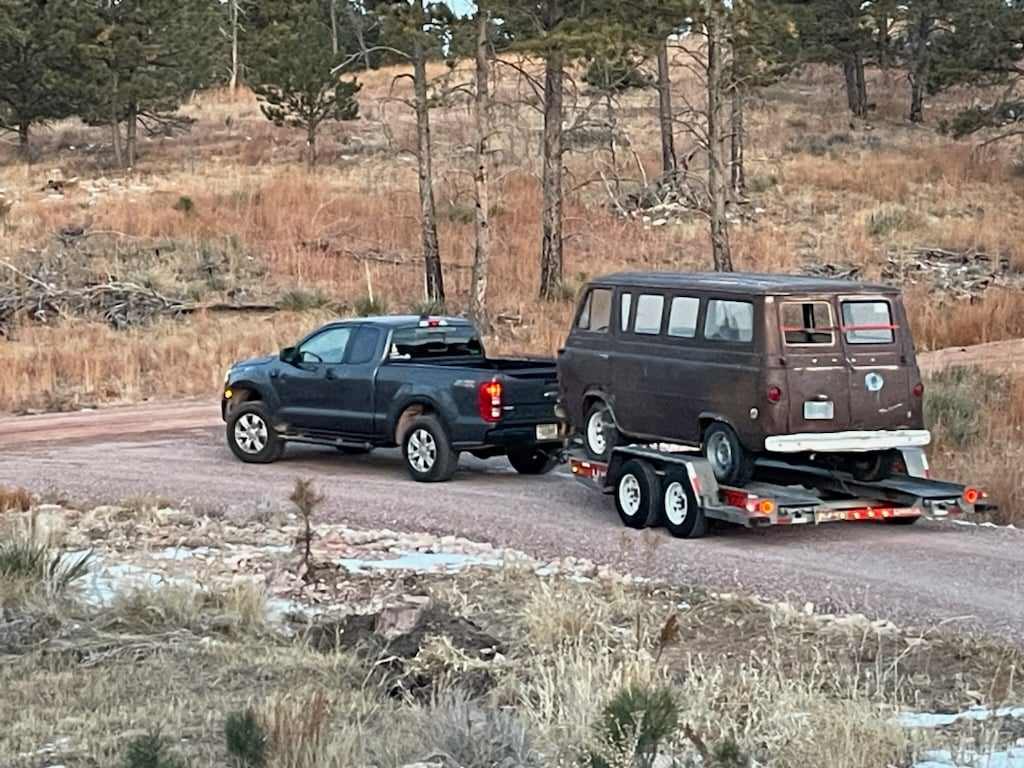
The photos attached to the message from my brother-in-law were of a 1965 Ford Falcon window van, which was the upscale passenger carrying version of the more utilitarian Econoline van. The Econoline/Falcon vans were cutting edge in their day and not only invented the van as we now know it but were also quite efficient 20-30 mile per gallon performers when introduced 60 plus years ago. This one was also geared so it should cruise along comfortably at 65-70 miles per hour, a plus when traveling out west. It also has the ubiquitous “Big Six” engine. One should be able to find parts whether in Tierra del Fuego or Deadhorse, Alaska, or all points in between should the bulletproof platform ever require a little road or trailside love.

This was the hippy van I had been seeking for three long years.

The hippy van may have been located only three miles from my sister’s home in the Black Hills of South Dakota, but it was 800 miles away from mine. A loose plan was hatched to wire my sister some money and have the seller deliver it to her home. I would get it out of her yard at some vague date in the future.

That vague date eventually morphed into the delivery day, but a prior volunteer commitment meant I would arrive 8 hours late. I called the seller. “No problem, we can just roll it off the trailer”, he reassured me.

Worthy of note-this 1965 Ford left the assembly line cloaked with an absolutely gorgeous Prairie Bronze Metallic paint scheme, that same gorgeous color of many a classic Mustang. Somewhere along the line, somebody opted to paint the old van the more mundane color of Beaver Brown.

About midway of my travels between Wisconsin and South Dakota, I received a text from Sister Suzie stating, “Brown Betty is coming off the trailer”. Over the next 2 ½ hours I received multiple texts and videos attesting to the same, but Brown Betty was seemingly OK with staying on the trailer.

Coming off one trailer
And onto another.

It turned out that the trailer Brown Betty was on was not a car hauler trailer but a homemade flat top trailer with a high deck, all four of Brown Betty’s tires were hopelessly flat, and the rear wheels were locked solid. 2 ½ hours later and with the help of a John Deere tractor with a front-end loader, Brown Betty was finally off the trailer and on the ground. No problem? I arrived 8 hours after that drama.

Interestingly, my nephew loaned some tires that held air, and when Brown Betty was popped out of gear and had inflated tires, she rolled effortlessly onto my car-hauler trailer.

My sister then offered me the Southern Black Hills tourist experience. Her normal ride to the commerce hub Rapid City takes her through both the Custer State Park as well as Wind Caves National Park and there are frequent buffalo encounters. She wanted me to experience that.

We drove along but saw no bison then turned into a siding to turn around. Suzie pointed out a delivery truck stopping a short distance away, and sure enough, there was one bison on the road. What we did not see is that the main herd was abreast of us.

One big old buffalo broke from the herd and sauntered intently and purposefully toward my truck. I felt a little uncomfortable and backed around and aimed the truck towards the exit. The old Grandad Buffalo sauntered first toward my Ford Ranger, then swung around the front and gave Suzie and I a long stare down across the hood.

He then sidled around to the driver’s side door. There was a scratching noise that sounded like 80 grit sandpaper dragging across the side of my late model pickup. “What is the etiquette here?”, I asked Suzie. “I don’t know. This has never happened to us before”, she said. “Well, the paint is ruined so we may as well enjoy this”, I replied.

Soon five others from the herd sauntered up to my pickup and began vigorously licking as well. It then dawned on us that I had driven out of Wisconsin in a snowstorm and the sides of my pickup were white with road salt. My Ford Ranger was now a buffalo lick.

In my wildest dreams, there was never the thought of staring directly into the eyes of a one-ton land mammal with a little more than one foot of distance and a thin piece of glass separating our foreheads, but that was exactly what happened. Eventually a young bull came in from the side and began head butting and irritating the old Grandad Buffalo. When the old ‘buff began to get wild eyes and his tail stood up, I told Suzie, “Am starting to feel a little uncomfortable”.

“But look how close the bison came, and we did not end up like foolish tourists and get gored or tossed up into a tree with our pants torn off” she replied giddily.

Oddly enough and despite the horrible scratching sound, upon being washed the truck did not have a single scratch from the buffalo tongues!

Suzie later brought me to the Wolly Mammoth Site that features mammoth bones, not fossils, exposed in situ and as found. One of the skeleton’s was laying so poised and intact that it almost seemed like one was interrupting a Wolly Mammoth during a nap.

So, after the drama and after the wonderful Black Hills experiences, Brown Betty found her way to her new home in Sconnie. The last stop for fuel towing her home was late at night at a convenience store in Hinkley, Minnesota. “Sweet van, man”, the Gen Z dude tending the counter said.

The thing about classic vehicles is that all of the best intentions and plans and dreams might be for naught. Currently, the plan is to ditch the Brown Betty moniker and paint her bright orange metallic and Wimbledon white, somewhat of an homage to the 1960’s V-Dub pumpkin orange and beige scheme. A basic camper interior would make her a fuel-efficient efficiency apartment and World Expedition Vehicle. And with retirement looming on the horizon, a World, or at least Western Hemisphere expedition might be just what the doctor ordered.

Or she may end up sitting neglected and untouched in the garage for the next decade before being sold off for pennies on the dollar, just like most classic vehicle projects.

Stay tuned.

Surfing Wisconsin

Along with turning thirty came the realization that the dream of living in a quaint surfside shack on the California coast and riding the waves had gone unfulfilled. Not a single finger was lifted in those first 30 years to make that surf life happen, so it was surely a fantasy.

But I wanted to surf. I had never seen a surfboard in real life but had a back yard workshop and a well-stocked beer fridge, and with a little help from some mail order plans, I built a surfboard.  

It almost made perfect sense, as 15 minutes out my back door is that mighty inland sea, Lake Superior. But I had no idea if a surfboard on Lake Superior could work.

An old Beach Boys song instructed me to be waxin’ down my surfboard and it was polished and buffed and waxed until water beaded up upon every square inch but was too slick to ride upon.  An ad in a surfing magazine found in a Yooper newsstand had the phone number for a Huntington Beach, California surf shop, and I called for advice. The salesman asked where my home waves were and what the water temperature was. My reply “Wisconsin, 30 something degrees”, begged his curious follow up, “Celsius”? There was an awkward pause upon my answering, “No, Fahrenheit”.

The Saxon Harbor Special

He then graciously pointed out that wax was applied to the top surface of the board to make it tacky, so the surf rider doesn’t slip off. “You are going to need extreme cold-water wax”, he said matter of fact before launching into a half hour over-the-phone surfing lesson-his due diligence, no doubt meant to keep me out of the obituary page of the Iron County Miner. For years to come, extreme cold-water wax and surf shop stickers magically appeared in my mailbox free of charge, positive reinforcement from afar.

The first noticeable improvement with using board wax was that I didn’t fall off the surfboard all the time. I started to get the hang of it and started to have some fun. But the learning curve to surfing Wisconsin was steep. The waves were not luxurious nor well-spaced like those along the coasts, but were cold, hard, closely spaced, and crashed into the beach. The rides were short and kamikaze like and the endings were barely controlled crashes.

The Beach Boys again disappointed by promising fun-in-the-sun while surfing. If the sun is shining in Wisconsin, the surf ain’t up. The opportunities for the best waves were limited to those knee-to-hip high that built for an hour or two as a storm approached but before the storm’s actual landfall. A storm rolling across Lake Superior is common, but a storm producing those waves is not.

A wicked Nor’easter rolling in would find the fair-weather beach bums hastily collecting their coolers and folding chairs and scampering away toward the parking lot. I did the opposite and scampered, board under arm, toward the building waves.

At first, I told no one about Surfing Wisconsin. And it was not a big secret, driving around in stormy weather with a surfboard sticking out of the back of my vehicle. About a year in people began asking questions and I began to answer, and the idea was met with skepticism, snickers, and rolled eyes. But those folks were stuck on dry ground, and I was out there surfing.

In late March, a big storm was predicted, and the nearshore weather and maritime alerts fired off.

I raced out to Saxon Harbor and was greeted by waves larger than any I’d ever rode before, and they were quickly building to overhead. Those waves came in an unusually orderly fashion and rolled landward in a most graceful form before crumbling into the shoreline, conditions I had not seen before on Lake Superior. In my eyes those waves were monsters and were huge and scared the shit out of me, but this setup had the potential for a best day ever!

It was easy paddling out in the relatively calm water between the break walls of the safe harbor and then entering between two well-spaced waves. The surf gods were smiling, and my board caught an incredible wave that took me on the most exciting ride of a lifetime, a truly other worldly experience. That wave then crumbled harmlessly short of the shoreline, allowing time to collect my board and make a hasty exit up the rugged boulder face.

My second time out, entry was not easy, and the timing was way off. My board awkwardly caught an incoming wave and raced uncontrollably down the face, stalling out at the bottom.

That wave crashed from above and slightly behind causing an abrupt smackdown, grinding my face into the sandy bottom.  Amazingly I surfaced no worse for the wear. But a split second later the board rocketed to surface and struck me in the face. Everything suddenly appeared bathed in white hot light, and I saw stars.

The next moment of realization was of sitting upon a boulder and facing the water, the surfboard still leashed to my ankle and getting battered against the toe of the rip rap by each incoming wave.

A quick wellness check revealed a hole bit through my lower lip and two broken teeth, the right corner of my mouth was torn and that side of my face drooped. My neck was damaged.

Once home, I Superglued my torn face back together. “Thank goodness you made it home”, my former wife sighed, and then quipped, “Imagine telling everyone you drowned on a lake in Wisconsin, surfing!”

For seven more years, I continued to surf Wisconsin, perhaps slightly more cautiously after the wipeout. That old longboard eventually became a mere decoration hanging in the cabin rafters.

And there was never another ride as spectacular as that first ride on the day of the big wipeout.

I thought summoning the courage to enter Lake Superior’s pitching seas and tapping into the awesome power of her waves somehow made me a bad-ass surfer. But it was her making the waves all along, I was merely another piece of flotsam tossed about in just another storm.

And I will never fully comprehend the mercy of her coughing me up, a dreaming fool in over my head during a big storm, then delivering me to the safety of the shore.

Reality Check

The genesis for this blog was to answer the recurring questions asked about stepping back from our modern lifestyle and getting lost in the forest. Folks often asked, am I living in a Unabomber shack? (Hardly, I think it to be quite luxurious). Is life difficult and had I become a hermit? (No and no). Do I shit in the woods? (Occasionally, if only to spite the bear that occasionally shits in my yard).

Some of these posts and musings have gone off on tangents, some have retold stories that being immersed in a different world has helped me better understand. Some posts have stayed true to the original mission and detailed a simpler lifestyle.

With no master plan and perhaps because of simple dumb luck, it has been my good fortune that every stage in my life has become its own adventure of a lifetime. So, has getting lost in the forest improved my life? Has dropping off the grid been working out? Is living life without a Plan B a good thing?  

An immediate observation once settled in out in the forest was that we are groomed throughout life to be good worker drones and to live within the rather stifling and judgmental parameters and confines that our society has established. In this model society our workday is structured, our home routines are routine, our packaged entertainment is mind numbing, and the carrot dangled just beyond reach is a vague and ill-defined dream. Our modern world values uniform round pegs and uniform round holes, neutral colors, music for mass audiences, and owing just enough of your soul to The Man that you cannot step out into your own world.

For those living within this model and fortunate enough to have a brief period of the day with no outside demands nor interference, there comes the added societal pressure of suddenly shaking off the cloaking’s of regimentation and plunging into a state of mindful bliss. We are led to believe we can flip a switch deep inside and magically find a moment of Zen; find self-induced quicky Nirvana.

Rather than waste a life away within a structure and model created by others and in search of that elusive and fleeting moment, why not simply create and lead a larger and more meaningful life brimming with Zen?

In this new life, upon exiting the blacktop and venturing home to the forest the worries and absurdities and the stress of time associated with modern society melt away. A sense of calm and sensibility and timelessness permeates my soul. It is obligatory to routinely step back into organized society to participate in the workaday world and do chores and shopping. The breezy joy of simplicity is snuffed and replaced by weighty confines of the modern world with each step away from the cabin and out of the forest. 

As told before, this journey began with the implosion of a marriage and the retreat to a wooded piece of property while fate ran its course.

It is a vigorous but not difficult existence. For example, heat is supplied exclusively by firewood, but the making of firewood is wonderful exercise and if leisurely paced, is relaxing. Firewood is also a perfect example of the self-reliance of living off the grid. The firewood must be cut well enough in advance to be properly seasoned, and in quantities sufficient to carry through the long Northwoods winter. Not enough or it being too green makes for some cold nights when the mercury dips below zero.

It is also very gratifying to rely on solar and wind generation to supply electricity. By reducing unnecessary consumption, a rather diminutive windmill, solar array, and battery bank have proven sufficient. This small system can provide power through 9-10 days with neither sunlight nor wind.

Getting rid of the television and its mind-numbing drivel was one reduction in the electrical load that has dramatically improved the quality of my life. My advice to anyone, anywhere, is to turn off the TV. Pick up a book or newspaper, play with the kids or the dog, maybe fool around with your lover a little more instead. You will feel a lot less anxious and angry and a whole lot better about the world around you. Your lover just might as well.

No mortgage, no regular bills, and being largely self-sufficient also frees the soul from most of the traps set within our modern world. It is nearly impossible to be beholden to The Man if The Man has no hold on you.

In my old life, I thought of myself as adventurous. There was travel to wild places as well as a work life that many folks would have to tune in to the Discovery Channel to experience. But the travel was largely taking two or three weeks out of fifty-two to follow trails blazed by others. And the work life was being employed in adventuresome and far-flung locations off the well-worn path, but as one tiny cog on the massive wheel of a well-oiled machine. 

Ultimately, true adventure is not pre-programed nor planned.  Adventure is the product of not knowing the outcome of striking out on one’s own course, whatever that course might be.

And with adventure comes the potential for misadventure. Fortunately, the misadventures of becoming lost in the forest so far has caused no lasting harm, the gravity of those misadventures fades quickly, and the lessons learned become deeply ingrained. Becoming solely dependent upon one’s own wits leaves no one to blame for dimwittedness than oneself. That could be a whole ‘nuther series of blogs.

This was not simply a withdrawal from society nor is it assuming a hermit’s existence. It is simply a relocation to a more inviting environment. Indeed, I used to live beside a busy highway, but was lonely. Since moving out into the forest there has been an abundance of visitors dropping in as well as random folks who pause to chat when passing by on the nonmotorized trail that runs a stone’s throw from the cabin.

It is so much more rewarding to know the time of day by the loon’s callings or by the position of Ursa Major in the dark sky of a Northwoods night than to stare at a clock. Understanding that the mercury has plunged far below zero by the bat strikes ball report of the stately hard maple trees cracking in the otherwise silent and still chill creates a sense of awe far beyond the hyperbole any television meteorologist could possibly impart. The wonder and majesty of a world far more magnificent than any that could possibly be dreamt of or created by mankind lies just outside of my front door. 

So, at the bottom line, has becoming lost in the forest been worth it?

The most obvious answer is that the best outcome would have been that four years ago the marriage survived and the two of us would have created a best life.

That did not happen.

So, this often-mind-bending series of events has resulted in my becoming lost in the forest. I am exactly where I belong, it is the adventure of a lifetime for this stage of life, and it is a wonderful place to be.

Even when the bear shits in my yard.

Sheena, Chico, and Cholo

The first time I met Sheena did not end well.

Half Golden Retriever, half Irish Setter, Sheena was a gorgeous dog with a fiery red-orange coat and magnificent, elegant feathering. Her chest was deep and her build slender and athletic. Her movement was graceful and fluid, she simply glided along with paws barely touching the ground.

She loved ear scratches and petting. But there was an issue with mussed up hair once the affection was over. She would wildly flail her head back and forth. She also drooled profusely.

My future bride first brought Sheena to the gas station where I was working for an introduction. We got along quite well. Until the ear scratching stopped. She shook her head wildly and elastic strings of drool wildly catapulted out in all directions and spooged a parts display.

It took a very laborious hour to meticulously clean up all of that dog spit.

Sheena had limitless energy that simply could not be burnt off and there was no amount of exercise and attention that was ever enough. Even the tiniest slight was made known by discreetly tearing the garbage open and methodically and evenly depositing it across an entire room. For Sheena, revenge was best served cold.

Upon approaching the breaking point and nearly ready to begrudgingly accept that perhaps not every dog/human relationship will work out, somewhere deep inside Sheena a switch was flipped. Perhaps somewhere deep inside of me a switch flipped as well.

Sheena rather suddenly was no longer a spastic dynamo but was refreshingly chilled out, and no longer constantly ran aimlessly and pointlessly about the house. After playing and exercise the beautiful red-orange dog would gently snuggle up, coyly sliding her head under hand for some ear scratching. Also gone were the days of being a wild terror in the car, bouncing from front to back, from window to window maniacally barking at every pedestrian, squirrel, bird or airplane overhead, and every other car in sight.

Instead, she would simply climb into the car and sit in the passenger seat in a most stately fashion, head held high, never breaking into bad posture and knowingly gazing about at the very things that had previously reduced her to a spastic lunatic. Sheena looked more like the Queen of England majestically riding in a motorcade than a dog out for a car ride.  

And just as water seeks its own level, the wild dog with boundless energy settled down and I adapted to her as much as she adapted to me. We became trusted and constant companions. Unless context warranted it, we were always together.

Sheena had within her all the energy of a stick of dynamite but unfortunately also had a very fast fuse. She graced this world for only nine very dynamic years.

It was impossible to count exactly how many were in the litter. It seemed like a swirling vortex of yipping and nipping chaos, except for one little dog profound in his calmness. This was the era of Tinker the Taco Bell dog, and my then wife and I had responded to a “Chihuahuas for sale” want ad.

Chico and Angel

The sedate puppy had a chocolate brown with tan coat that was not as sleek as the others and was adorned with somewhat Groucho Marx-like tan eyebrows. His features were not as chiseled and distinct as his siblings and cousins. But his demeanor was distinctly laid back and his eyes were large and dewy and soulful. I no sooner picked him up and cradled him in my arm before he crawled upon my shoulder and was licking the side of my face. After that, there was no argument to be made that the prettier dogs in the litter would be a better fit than this less than perfect example of the breed. And so, Chico came into our home.

Chihuahuas have a deserved reputation for being saucy, smart, stubborn, moody, and yippy. Chico was no exception but in situ was affable and good natured. Indeed, he enjoyed the attention and affection from random strangers despite being fiercely loyal and protective of me.

Everybody loved Chico.

Chico was also clever enough to run a con. He astutely learned the boundaries of the yard, knowing there would be no leash by staying within them. The scam was to patiently wait until I was not paying attention for a moment, then make a break to venture into the tall grass of a nearby vacant lot for some exploring. He was also smart enough to sneak back in from another vector when I went looking for him.

Chico also had a little bit of a drinking problem. During a barbeque or back yard get together, if someone happened to put an opened can of beer on the ground the scam was to stealthily creep in then quickly tip the can over, vigorously lapping up as much as possible before we could scoop him up and away from the spill.

Our yard in Lake Havasu City was fenced in, very large and lush, a real-life oasis in the middle of the desert. This became Chico’s personal domain, and he assumed the all-important role of Protector of the Oasis. One day while chasing an archnemesis, a collared lizard, his head became lodged between two fence slats, and he began violently and uncontrollably jerking backwards trying to break free. The slats were able to be parted slightly and Chico popped free then staggered backwards a few steps before collapsing onto the ground. I feared his neck was broke and stood there petrified, too flabbergasted to even think about getting him medical attention.

After what seemed an eternity, he miraculously sprang back to life as quickly as he had collapsed, only to tear after a foolishly bold quail that had the audacity to venture into his domain. The Protector of the Oasis was back.

Chico’s most endearing quality was being an affectionate and constant companion, using his stealthy ninja skills not only to topple opened beer cans, but to sneak up onto my lap. Whenever I sat, the little brown dog would magically appear from nowhere. Being a morning person and apparently, Chico also a morning dog, it was a ritual to sit together and eat breakfast and welcome in the new day while the rest of the world slept.

Years later, a gifted artist friend created a portrait of Chico that hangs by my breakfast table. In spirit, to this very day we welcome in the new day together.

One evening Chico seemed out of sorts, so I slept on the couch with him cradled in my arms. At bar closing time, the roar of an obnoxiously loud motorcycle thundered through an open window and stirred us both out of sound sleep. To calm him, I petted Chico and spoke softly, and his breathing first relaxed then stopped. I cried shamelessly.

Some folks may unwittingly say that a dog is just a dog, but they are wrong. A dog is a living being that can mystically connect us in a way many other “animals”, including some human simply cannot.

Time marched on but there remained a void. “I know you are still upset about Chico”, my then wife said nearly a year later, as I stood brushing my teeth. I spit, said nothing, and upon turning towards her she revealed the tiny black dog and set him into the crook of my arm.

Initially there was a momentary flush of bitterness that another dog could somehow replace my departed pal. I reluctantly began petting the little black Chihuahua and within a few moments his tail wagged feverishly, and he crawled up onto my shoulder and was soon licking my neck and cheek.

Whereas Chico was not the most stellar example of the breed this dog’s appearance was magnificent. His coat was sleek and black, his features picture-perfect, and his dark eyes were large and dewy and soulful. But unlike Chico, this dog’s eyes had a devilish twinkle. This little black dog was cocksure and had swagger, he was a somewhat of a gangster.

A doggy mugshot

We named him Cholo.

And Cholo was indeed not a replacement for Chico but became a constant companion in his own right. He shared many of the endearing traits common to the breed but had a personality unlike any other dog I had ever met before. Evidently Cholo never got the memo that he only weighed six pounds.

Cholo took on the role of Protector of the Yard and then took it to new levels. He was not scooped up to prevent lapping up the occasional illicit beer spill, but to prevent being him from being shredded by dogs twenty times his weight that he ferociously tried to rout out of the yard.

You see, Cholo can somehow make it known to all creatures great and small that this is his world, and the rest of us just get to live within it.  He is the most kind and loving and loyal dog when idyllically settled into lap before hearth in home. But if anything, or anyone dares intrude, meet the Joe Pesci of the dog world.

Pound for pound, the toughest dog on the mean streets of Hurley.

My mind’s eye caricature of this little gangster dog would be as a gun toting rebel plying the deserts, a bandolier across each shoulder, but Cholo is actually somewhat of a mariner. Often in the summer I would grab two cans of beer and a bar of soap and row out to the Owl Rock for a swim and to wash up. It simply never came to mind that a Chihuahua might enjoy such a thing. But life is a great experiment, and despite having doubts and misgivings, one day Cholo came along.

He loved it!

He would perch precariously outstretched on the bow cap, nose thrust into the wind, toenails feverishly clawing to hang on with each stroke of the oars, a little black Chihuahuan Figurehead. Once beached at the Owl Rock, he would slowly and methodically examine and sniff each of the thousand or so owl pellets, occasionally gently rolling a particularly interesting specimen over with his paw for a more in-depth examination and whiff. It took Cholo the same amount of time to examine the owl dung as did for me to swim, bath, consume two beers and then dry.

Unlike Chico, Cholo was never clever nor subtle nor sneaky in the escape plan. His unwavering method when unleashed was to simply march away in whatever direction fancied at that given moment, and he could not be called nor lured back and would have to be caught or captured. To satisfy his lust for freedom, occasionally we would row out the Otter Island with the obligatory two beers and bar of soap. Being a tiny island, he could run free for hours, until exhausted, without the fear of him running away never to be seen again.

During each chapter of my life there has been the companionship of a dog that meant as much to me as the people and places and things also present at the time. However, there has not been a dog in my life for the last 3 ½ years, probably the longest stretch ever without a canine pal. My human friends were constantly on “dog lookout” and suggested some potentially wonderful companions, but for a myriad of reasons it just never happened. The stars simply did not align.

That changed recently. Despite being a bit apprehensive, a new friend Stormy has entered my life. She is very smart, clever, well behaved, and loving. She is also loves being outdoors and rather rapidly moved me into a much more vigorous daily exercise routine. We take many walks together!

Stormy

Stormy is the perfect canine companion for this chapter of my life. I hope to be a good human companion to her in return.

Endings and Beginnings

“Daylight in the swamp!”, Grandpa T would bark out at 4:30 am on the opening morning at deer camp. That old wakeup call from his lumber camp days was a stark message to those of us spending our first season out at camp that it was time to trade the toasty warmth of a sleeping bag for feet on the cold camp floor.

Each morning he would rustle us young ones out of the sack in a similar fashion. And each new morning brought the excitement of the unknown and the promise of new adventure. This might be the day to harvest a trophy buck, to spend an entire day fruitlessly pursuing the elusive maker of a monster set of tracks, to go stir crazy with boredom in a blind or at a post, or to crash through thin ice while crossing a beaver pond then hoping not to freeze to death before getting back to the fire at camp.

By the end of that first deer season, “Daylight in the swamp” became less of an annoying wakeup call and more of the promise that even the most potentially mundane new day at deer camp was far superior to the best day ever of junior high school.

Sunsets are celebrated and for good reason. Obviously, they are beautiful and while most folks are snuggled in tightly and snoring deeply at sunrise, most everyone is awake to view the sunset.

The Northwoods is an epic place to see the setting sun. There are endless vantage points high upon both the Penokee Range and Basalt Ridges to bear witness to the day’s fiery end. And viewed from the shores of Little Girl’s Point or Saxon Harbor, one can almost hear our thermonuclear reactor sizzle as it melts into the cold waters of Gitchii Guumi.

But a sunset is just that, a sunset.

Anything government can do that will actually help you will eventually sunset, bonus plans sunset, benefits sunset, lives sunset, relationships sunset, suns set. A sunset is the ending. Whether it was the best day ever or the worst day ever, the setting of the sun is the death of that day. The end.

And while there is not a famous sunrise Strip and the biggest selling song about a sunrise involves a heartbroken cowboy lamenting an ill-fated love triangle over a bottle of tequila into the dawning hours, the nerdy bookish sunrise deserves the same reverence and attention as the smoke show cheerleader sunset.

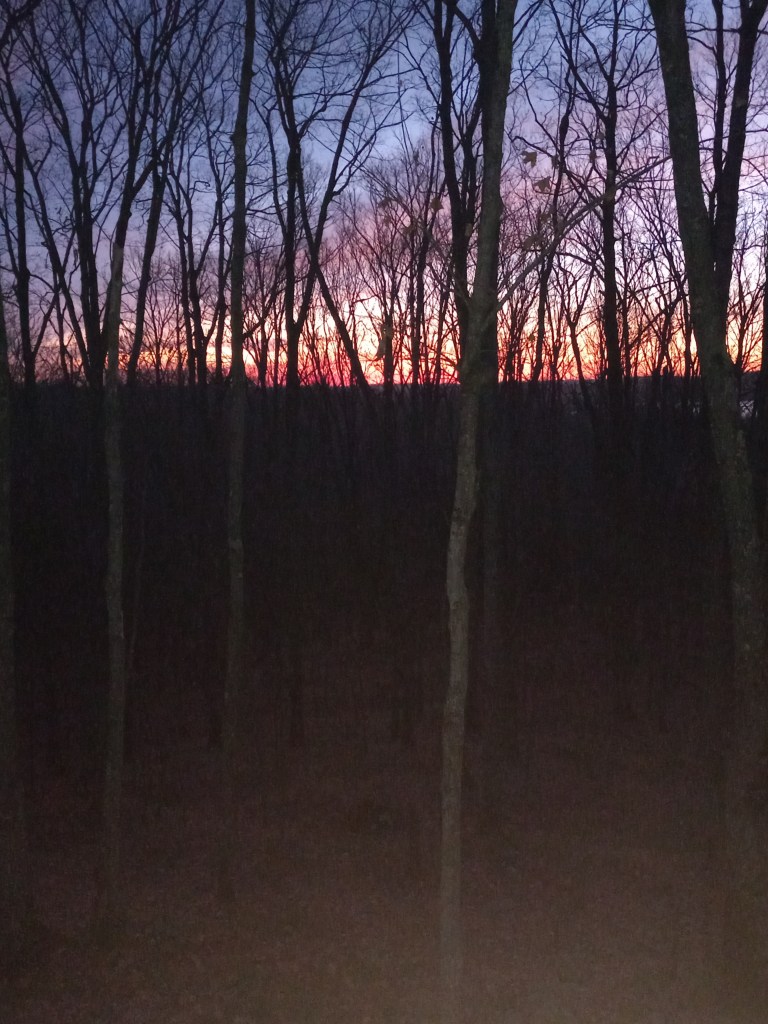
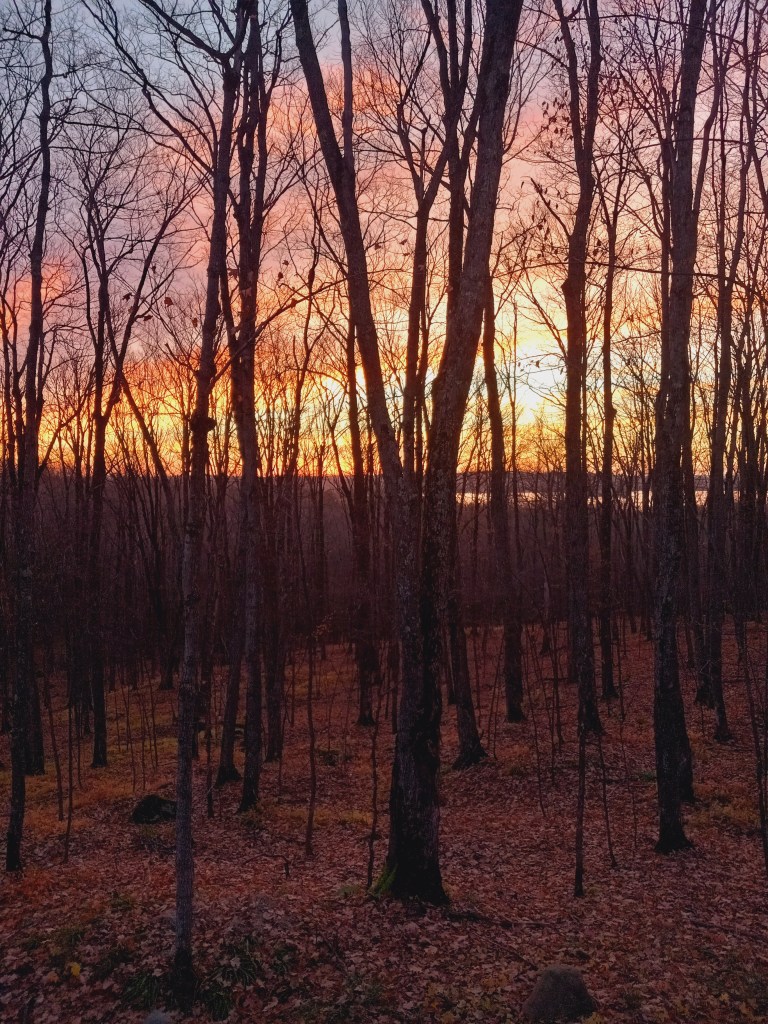
Most mornings I stand before the patio door coffee cup clenched in hand and witness the birth of a new day. At first light there is a tease, a dramatic splash of rich colors cast by a sun flirting below the horizon like an ecdysiast from the days of yore flirting behind the fringes of a sheer curtain.

The clouds then turn deep shades of plum as well as wild shades of pink and peach, a slow-motion kaleidoscopic orgasm of light and color akin to a visual rendition of the climactic orchestral Theme To 2001-A Space Odyssey, followed by the sun then bursting over the horizon with such drama and majesty that one can feel the earth rotate under foot. And so, a new day is born.

Unless we become trapped in Groundhog’s Day, we will never live exactly the same day twice. And with each beautiful sunrise comes not the promise of a same old same old ending, but the promise of a new and possibly better day, and possibly the best day ever.

Perhaps that is what Grandpa T meant to impart when he barked out, “Daylight in the swamp!”  

The Adventures of Steam Punk

“Wow”, I uttered slack jawed, standing in the pouring rain, gazing in through a hay loft door at the mechanical monster.

“Yup. Pretty steam punk”, the owner said matter of fact. “It’s been here since they built the farm”.

Nearby nestled in the trees was a quintessential Victorian Era brick farmhouse and we were standing outside on the earthen ramp, gazing into a typical Wisconsin dairy barn hayloft. It had been at probably at least a half century or more since agricultural activities onsite had ceased, as the pastures and croplands and hayfields were since replaced by the now mature forest, giving clue to just how long ago “since they built the farm” was.

It would have been common for the pioneer farmer to purchase precious pieces of equipment essential to the construction of the dwelling and the expansive dairy barn, such as a drum mixer. Concrete could be mixed to pour floors in the barn and for construction of the dwelling, as well as to mix the mortar necessary to lay the over one hundred cords of field stone in the dairy barn walls, plus the mortar for the stone home foundation and brick veneer. Terrazzo poured from the mixer would give the farmhouse floors timeless elegance. Indeed, the inside of the poorly cleaned mixer drum was encrusted, and the paddles looked like broken arms immobilized by plaster casts of Terrazzo, left to harden over a century or more ago.

I was preparing to build my sauna, The Sauna on the Rock, and getting a ready-mix truck into the undeveloped location perched upon a bluff to pour a monolithic foundation and slab was out of the question. Concrete would have to mixed onsite.

The easy thing to do, indeed the smart thing to do, would have been to simply buy a new mixer. I was travelling through south central Wisconsin and drove past at least a half dozen of the big box home improvement stores native to Wisconsin. Any one of those would no doubt have a half an aisle full of shiny flimsy brand-new Chinese made mixers at a ridiculously low price, with an 11% rebate in the form of an in-store credit to boot.

But I didn’t want a Chinese mixer, happened to be passing through the heart of America’s Dairyland, have a certain fascination with online marketplaces, and a certain obsession with old junk.

We stepped out of the rain and into the hayloft.

The base of the mixer drum was heavy cast steel and skirted by an angry and hungry looking exposed ring gear. The drum itself was rolled plate steel joined with acorn size hand hammered and bucked rivets. The tiny pinion gear was mounted on a shaft opposite a freakishly large belt pulley. The original power source had long since disappeared, having been replaced by an electric blower motor pirated from a discarded forced air furnace and its weight held the belt in tension. There were no guards or safety devices, not even a shutoff switch. This machine was built in era when the only protection the operator had was their own wits.

“How much?”, I asked.

“Sixty bucks”.

“Does it work?”

“Dunno. Cord is bad but we can try”.

We were both soaking wet, water dripped in through the barn roof here and there, and the planking on the hayloft floor was well saturated. Messing with electricity and a bad cord did not seem like the most prudent thing to do. Sixty dollars was fished out of my wallet and handed over without further discussion.

I had just purchased a sixty-dollar lottery ticket that did not come with an 11% rebate in the form of an in-store credit. The mixer was loaded up and hauled north.

A cast-off power cord in only slightly better condition was dug out of a scrap pile then installed. The old furnace blower motor eagerly spun to life and promptly shredded the old drive belt, which had been weathered to the white wispy appearance and tensile integrity of the burial veil of the crypt keeper. A new belt was purchased for seven dollars, effectively transforming the mixer into a $67.00 lottery ticket. But once the new belt was installed and the slightly better cord plugged in, the beast clattered and clanked, and the drum spun to life. Winner, winner, chicken dinner.

Pour day for the Sauna on the Rock was ridiculously hot. My then 76-year-old dad showed up early, eager to help. He shoveled aggregate and sand and Portland cement and fed water into the drum all day long. The generator hummed as the mixer clattered and clanked and dutifully dumped out wheelbarrow load after wheelbarrow load of perfectly mixed concrete. By the day’s end the pour was completed, and I was overheated and wore out and exhausted. But both my dad and the mixer were daisy fresh and looked like they could have continued on for hours. They don’t make ’em like that anymore.

During the flawless performance pouring the sauna foundation, the antiquated and rusting and inanimate hulk took on a certain amusing and animated and quirky persona. I nicknamed the old mixer Steam Punk.

Steam Punk served well, subsequently pouring a privy slab, mixing mortar for field stone and cement block and grout, as well as mixing some mortar for my brother’s stone masonry. Once the projects were all done, Steam Punk was ignominiously tucked away out of site in the woods, but was never quite forgotten.

“Do you know where I could borrow a mixer?” asked civic minded Steve. He had volunteered to mix and pour some concrete for a project at the local humane society. “No, but I know where there is a mixer you can have”, I replied.

“It’s quite steam punk”, I quipped as we wrestled Steam Punk onto his trailer. “Heavy, too”, Steve grunted.

Steam Punk performed flawlessly at the humane society. When Steve asked when he could return the mixer, I replied he should gift Steam Punk to the next benevolent project.

The next benevolent project materialized soon enough when civic minded Neil needed a mixer to pour some concrete to remedy a safety issue at the egress of a 4-H Exhibition Building. Again, Steam Punk dutifully cranked out batch after batch of perfectly mixed concrete, which was poured by civic minded Neil and his civic minded dad. They just don’t make ’em like that anymore.

Just as each of us humans have a certain weakness or fatal flaw that may hinder our abilities or worse yet, kill us, so it is with Steam Punk as well. Despite his hefty cast steel construction and rolled plate steel drum and hand hammered and bucked rivets, what will ultimately disable or perhaps even destroy Steam Punk is the lost art of the babbitt bearing.

In this day and age, the bearing of a rotating shaft is borne by ball or tapered roller bearings, or perhaps by an insert bearing. Steam Punk, however, is from a different era when molten babbitt material was carefully poured and then the pinion shaft was masterfully fitted by a skilled craftsman. The minds containing that archaic technology and those hands possessing the necessary artisanship have long since gone cold. The well-worn babbitt bearing that carries Steam Punk’s wobbly pinion shaft will first occasionally skip a tooth, then one fateful day while under load will repeatedly skip then strip the teeth completely off either ring or pinion gear, effectively killing the old mixer.

And while Steam Punk may simply be an inanimate conglomeration of cast steel and plate steel and hand hammered and bucked rivets, the course of his working life has taken a very human trajectory.

In his younger days he played an active role in creating a homestead and iconic red barn for a fledgling agricultural enterprise that defined a young pioneering state in its rise to becoming America’s Dairyland. In his middle years Steam Punk was marginalized and destined for the scrap heap. Later in life, he reproved his trailblazing worth by being an indispensable part of carving out a new homestead in the Northwoods. In his twilight years, he is making the world a better place one pour at a time by mixing concrete for civic minded volunteer projects.

Long live Steam Punk.